
“Livin’ on the Edge” began not as a typical outside-writer pitch, but as a moment of pressure, instinct and recognition inside Joe Perry’s home studio, The Boneyard.
The broader atmosphere mattered. The song was written in the aftermath of the Los Angeles riots of April 29 to May 3, 1992, a moment when America’s racial, social and political fractures were impossible to ignore. Aerosmith were working on material for what would become Get a Grip, and Mark Hudson had been brought into the writing process. He came ready to do the job he thought he had been hired to do: bring riffs, hooks and ideas that sounded like Aerosmith.
Hudson’s first impression of Joe Perry was almost mythic. In his longer solo retelling, Joe is quiet, reserved and visually unmistakable: the rock guitarist in his own studio, with the look and presence Hudson expected. In the Fantasy Camp version, Hudson plays the moment for comedy, remembering himself trying to make small talk about the Boston Red Sox, the Yankees and clam chowder while Joe gave him almost nothing back. Hudson, who describes himself as someone who could talk to furniture or a park bench, feared it was going to be a long, difficult day.
Then Steven Tyler arrived.
Across the accounts, Tyler’s entrance is remembered as pure Steven Tyler theatre. In the Rebecca Cesarz performance, Hudson describes the sudden sound of a car, the door opening, and Tyler appearing with mismatched shoes, a model airplane and an energy that immediately changed the room. In the 2009 Fantasy Camp telling, Tyler is similarly recalled as a surreal, comic presence who made Hudson feel instant relief. Hudson’s reaction, as he often puts it, was that someone like him had finally walked in.
At first, Hudson played the ideas he had prepared. These were the riffs and fragments he thought would fit Aerosmith. Steven and Joe responded positively enough. Hudson had done his homework. But then Tyler asked the question that redirected the entire session:
What would you bring to the band if you were actually in Aerosmith?
That question cut through the professional mechanics of songwriting. Tyler was not asking for an imitation of Aerosmith. He was asking Hudson to stop acting like an outside writer and bring something from his own heart, soul and musical identity. Hudson has repeated this point in several tellings, including the Nube 9 version, where he frames the moment as the difference between writing for a band and imagining what he would bring if he were inside it.
Hudson’s mind went to John Lennon.
At that point in the early 1990s, Hudson felt disconnected from much of the mainstream music around him. In the solo account and the Rebecca Cesarz version, he jokes dismissively about the pop and dance-driven music of the era, but the deeper point is that he missed songs with moral and social weight. He thought no one was carrying the torch of Lennon’s message songs anymore, the spirit of peace, social conscience and collective unease that ran through Lennon’s solo work.
So Hudson played the beginning of the idea. He had the opening mood, the social anxiety, and the first movement of the verse. That was the spark.
According to Hudson, Tyler stopped him almost immediately. In different versions, including the Rebecca Cesarz performance and the 2009 Fantasy Camp appearance, Tyler recognises the Lennon influence before Hudson has to explain it. Hudson’s retelling turns the moment into a kind of spiritual validation: Tyler senses that Lennon is somehow “in the room”. That reaction gave Hudson what he describes as artistic relief. The idea was not too soft, too idealistic or too un-Aerosmith. It had landed.
From there, the song began to open up.
The first verse carried the central idea: something had gone wrong, not just in the world, but in the way people were seeing it. The lyric was not only political. It was perceptual. The problem was not simply out there; it was in the eyes, in the way society interpreted what it saw. That made the song broader than one event, even if the Los Angeles riots helped form the climate around it.
The chorus then gave the song its defining image: living on the edge. It was a phrase that felt unstable, immediate and universal. It could mean a society at breaking point, a person barely holding on, or a culture so used to crisis that it no longer knew how to step back from the cliff. In Aerosmith’s hands, that idea became both a warning and an anthem.
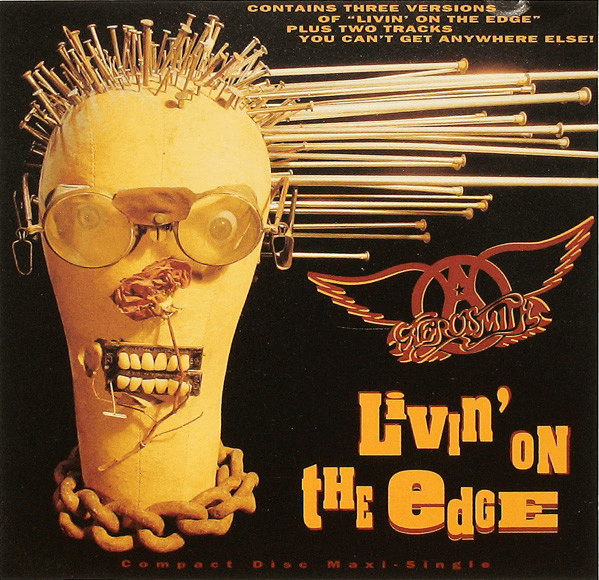
The demo version documented on the single release is especially useful because it appears to preserve the song before every final lyric decision had hardened. As reflected in the demo lyrics reference, the demo includes a more paradoxical closing idea: the world is described as “right” while everyone knows it is wrong, followed by a line about not being able to retrieve what cannot first be conceived. Hudson expands on that thought in the Nube 9 account, explaining it as a peace-and-action idea: how can people recover something if they cannot first imagine it, create it, or live it?
In Hudson’s memory, Tyler felt that wording was too much and reshaped it. The final version became cleaner, sharper and more direct. The change matters. Hudson’s early line had a more philosophical Lennon-like twist, almost a paradox. The final lyric removes that extra layer and cuts straight to the social diagnosis. It is less cryptic, more immediate, and better suited to Aerosmith’s delivery.
The most dramatic part of Hudson’s story is the bridge.
In his accounts, the verse and chorus were there, but he had no middle section. Steven pressed him: the song needed a bridge. Hudson, suddenly exposed, describes silently praying for help. In the solo telling, he calls on John Lennon, God and Jesus in a frantic internal plea. In the Nube 9 version, he says it came so fast he did not know where it came from. The important point is that the bridge was not carefully prepared. It arrived under pressure.
What emerged was the section built around the listener’s situation, complications and aggravation. The bridge shifted the song from broad social commentary into direct confrontation. It asks the listener to look at their own condition, their own anxiety, their own complicity. The “Chicken Little” image that follows, with the sky falling, makes the lyric feel both apocalyptic and absurd. The world may really be collapsing, or people may simply be trapped in panic, but either way the song suggests we keep crawling back into the same patterns again and again.
Hudson also remembers Joe Perry contributing a crucial musical moment around this section. In the Fantasy Camp retelling, Hudson recalls Joe identifying the “money chord”, described as B-flat, giving the bridge its lift and release. It is a small detail, but an important one: the story is often told through Hudson and Tyler’s verbal chemistry, yet Perry’s musical instinct helped shape the architecture of the song.
The Boneyard demo captures the song in a raw, transitional state. It sounds less like a polished album production and more like a live in-studio pass: a developing guitar riff, straightforward electric drums, and lyrics that had not fully settled. The Discogs single listing confirms the demo’s release context, while the demo lyrics reference helps identify the lyrical differences. Together, they make the demo valuable because it lets listeners hear the song close to the writing room, before the final version fully locked into place.
After the writing session, the song moved into the Get a Grip production process with Bruce Fairbairn. Hudson has told another key story from this stage in the 2009 Fantasy Camp appearance. After work on the record had progressed, Tyler called him urgently to come down to the Four Seasons. Hudson thought something might be wrong. Instead, Tyler sat him down, brought in huge speakers, placed them close, and played him the record. Hudson remembers Tyler becoming emotional by the first chorus. For Hudson, it was unforgettable because the finished track had not destroyed the song’s original feeling. It had become the thing he imagined it could be.
That may be the most important part of the whole story.
“Livin’ on the Edge” was not simply a song an outside writer handed to Aerosmith. It was born from Steven Tyler asking a better question, Mark Hudson answering with something more personal than he expected to share, Joe Perry grounding the moment musically, and the band recognising that a Lennon-inspired social conscience could be transformed into a 1990s Aerosmith anthem.
The song’s power comes from that tension. It has the moral unease of a protest song, the swagger of a hard rock single, the theatricality of Steven Tyler, the guitar authority of Joe Perry, and the outsider spark of Mark Hudson being pushed to bring himself into the room.
It also explains why the song still feels alive. In the solo account, Hudson says the song makes even more sense now than when he wrote it. That is because “Livin’ on the Edge” was never only about one riot, one year, or one cultural moment. It was about the recurring feeling that the world is tilting, that people know something is wrong, and that everyone is still trying to hold on.


Amazing (no pun intended) that I’m still learning new things about this record 33 years later. Livin On The Edge is a killer track. Truly an epic song. Aero hit it out of the park with this one.
Keep these coming!!
LikeLike