A private collector’s tape offers a rare window into the raw material that existed before Glen Ballard formally took the producer’s chair. The tape is a second-generation cassette, later transferred to digital, containing eleven tracks in various states of completion. Quality varies throughout: some stereo elements survive but the sound is often faded toward mono, likely from tape deterioration. Some tracks were recorded at slower tempos or in lower keys to accommodate Tyler’s voice in a demo setting.
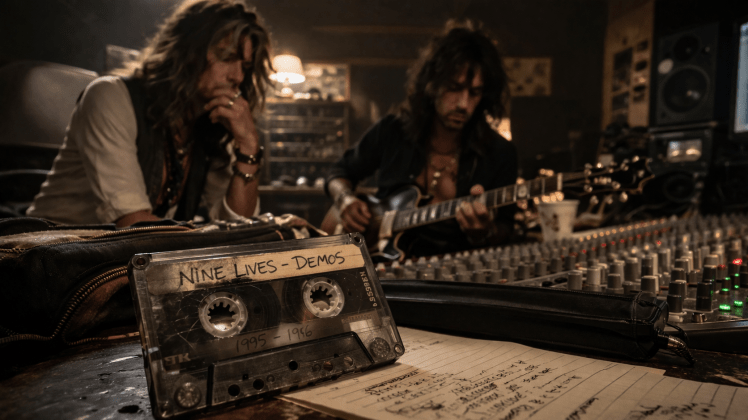
The tape is not a snapshot of a single session. It is a compilation spanning approximately nine months of writing — from Boneyard demos and the summer 1995 Desmond Child collaborations through the fall writing road trip and the first Marti Frederiksen sessions in early January 1996. Drums are almost entirely programmed throughout. It represents the working portfolio that Ballard inherited when the Miami sessions began in earnest: the album before the album.
Track-by-Track Review
- Falling in Love (Is Hard on the Knees) — Tyler/Perry/Ballard. Drum machine. Tyler’s vocals are strong but Perry’s guitars lack their final tone. The demo includes an extra bridge with lyrics later scrapped: “You’re on ‘do not disturb,’ have you been smoking herb, your Cheshire Cat is on hashish, own it, own it, own it…” This is the demo from Ballard’s garage studio in LA — “that little room where Alanis did her whole record,” as Tyler described it in Guitar World (April 1997). Written during the fall 1995 writing road trip, this is an early, playful version before the song was tightened during the Miami sessions.
- Pink — Tyler/Perry/Supa. Definitely a drum machine. Laid-back acoustic with Perry’s electric entering halfway through the verses. No guitar solo — just guitar harmonics and a flanged effect where the solo section would eventually go. Written in Miami, making this one of the earliest 1996 demos on the tape. Despite its simplicity, the demo felt so right that a refined version became the basis of the “South Beach” mix released on the single and later included on the 2002 compilation O, Yeah!
- Ain’t That a Bitch — Tyler/Perry/Child. The outlier on the tape: sounds like it could be a live band recording including organ, and female backing vocals. Guitar solo already close to the released version. Written with Desmond Child during the band’s summer 1995 Florida vacation — a second attempt at a title that had already produced a completely different song during the Get a Grip era. The polished state is consistent with Child’s reputation for delivering fully realised demos. When Ballard became producer, the song was presented to him but he opted to take the album in a different direction. It sat unattended until Child hustled his way into Criteria Studios in April–May 1996, sneaking in through the back entrance to confront Ballard about its absence from the recording list. A new version was likely tracked at that point — possibly one of the two versions that appear on the June 1996 Ballard mix tape.
- Something’s Gotta Give — Tyler/Perry/Frederiksen. Very early demo with 100% programmed drums. Chorus repeats the title as the band later performed it live. Marti Frederiksen is audibly present, ad-libbing comeback lines to the chorus. The general structure remained intact through to the final version. From the first-week-of-January 1996 two-day session — the track that proved Frederiksen’s value, the one Perry called “a freight train” when he phoned Tyler to come back to the studio.
- Full Circle — Tyler/Perry/Rhodes. Drum machine with heavy reverb on Tyler’s vocals. Early backing vocals — Tyler doubling himself a fifth higher, no harmony. Extra time on the break between the first chorus and second verse. The temporary guitar solo is shorter than the final and fades quickly. The final chorus starts with one pass and no drums — no buildup, no key change for the climactic section. The result sounds too repetitive; it was clearly Kevin Shirley who helped elevate this song for the 1997 release. Written with Taylor Rhodes in Nashville during the fall 1995 writing road trip.
- Fallen Angels — Tyler/Perry. A MIDI-sounding keyboard demo with apparently a single track of Perry’s electric guitar. Alt lyrics and alt sections throughout. Tyler hits every note but sounds uncertain on some background vocal melodies. The second verse includes an extra section with additional lyrics that were eventually deleted — the rhythm wasn’t great and they didn’t add much to an already long song; “when you’ve lost somebody, with a heart of gold, then you feel so empty, it makes you blood run cold”. Extra vocals appear during the solo. Someone joins for the background vocals in the final chorus, singing “where does fallen angels” — it could be Richie Supa’s voice. Points to a Boneyard demo from spring–fall 1995.
- Hole in My Soul — Tyler/Perry/Child. The earliest-sounding demo on the entire tape. MIDI sounding keyboards — likely Desmond Child, not Ballard. Written with Child during the band’s summer 1995 Florida vacation, built from a seed Tyler had been carrying since the Pump era. He told Guitar World (April 1997) he had considered giving it to Julio Iglesias. Alt lyrics, alt structure, buried vocals. No first chorus at all — just an alternate section that joins directly with verse two, including the extra lyric “it takes a group to do the crime.” The pre-chorus goes “is it over” instead of the final’s “cause if it’s over.” Verse two uses the alternate line: “I know there’s been all kinds of shoes underneath your bed, so I fuck with my boots on, that’s it, enough said.” Tyler’s background vocals are impressively high. Perry’s guitar arrangement during the chorus sounds unfinished and undefined. The solo has elements that survived to the final take. The song was complete enough to be performed at the Middle East club gig on 9 November 1995, but was never tracked in Miami — Perry confirmed in Metal Edge that it was among “a few tunes we hadn’t cut in Miami.” It went directly from this demo state to being recorded for the first time at Avatar Studios with Kevin Shirley in the fall of 1996.
- Roll Away the Stone — Supa. A Richie Supa composition given to the band for consideration during the 1995 pre-production period, or possibly in Miami while writing “Pink” with Supa. It carries a clear “Chip Away the Stone” vibe — strong riff, chant-style chorus — but unfinished lyrics suggest it was more of a Supa demo than a serious contender for the album. Aerosmith almost certainly never recorded a full-band version.
- Attitude Adjustment — Tyler/Perry/Frederiksen. Drum machine, but the lyrics and song structure are basically identical to the final release, including Tyler’s background vocals. The guitars sound real. The solo sounds like it could have been kept as-is — Brad Whitford is known for preferring to get his solos done in one or two takes, and Perry confirmed in Metal Edge that he flew the guitar solo directly from the demo to the final record. Written with Frederiksen in early January 1996, likely from the same sessions that produced “Something’s Gotta Give.”
- Crash — Tyler/Perry. Drum machine — very clearly fake-sounding. Tyler gets creative with how to record the fast chorus vocals. The demo sounds empty at times, like an early mix. Perry’s slide guitar is present. Handclaps appear during the solo section with an extra tempo shift before it. Tyler adds rapid breathing at the end of the track — he could easily have hyperventilated recording that take. A possible six-string bass part from Perry closes the track. A Boneyard-era sketch from 1995.
- Kiss Your Past Goodbye — Tyler/Perry. Drum machine. Rough-sounding guitars at the intro. A completely different solo from the released version. Impressive high vocals at the end — similar to what Tyler would do performing the song live, sustaining the final high note. Tyler wrote in his memoir that the song was “a premonition of the coming breakup” with Collins, placing the writing during the South Beach period. The rough demo state is consistent with a late 1995 or early Marlin Hotel composition.
What the Tape Tells Us
Ten of eleven tracks use programmed drums. Only “Ain’t That a Bitch” sounds like it could have a live band — consistent with Child’s polished demo style rather than the drum-machine beds that characterise the Tyler/Perry/Ballard and Tyler/Perry/Frederiksen demos. The tape excludes several songs known to have existed by this period — including “The Farm” and “What Kind of Love Are You On” — as well as everything written after mid-January 1996, such as “Nine Lives” (born from an AC/DC jam after the 21 January 1996 concert) and the Frederiksen DAT tracks like “Where the Sun Never Shines” and “When the Monkey Comes.”
What it captures is the shape of the album at its most embryonic: the collected work of nine months of writing across the Boneyard, Florida, Nashville, Los Angeles, and Miami — before the full band arrived, before Criteria, before the crisis. The songs are all here in skeleton form. Most of what needed to happen — the live drums, the finished guitar parts, the arrangements that Kevin Shirley would eventually bring — was still months away.
Sources: Private collector tape review; Guitar World (April 1997); Metal Edge (June 1997); Steven Tyler, Does the Noise in My Head Bother You? (2011); Joe Perry, Rocks (2014); Glen Ballard, Songfacts interview; Marti Frederiksen, Rock ‘n’ Roll Fantasy Camp Masterclass (2020); Kevin Shirley, Instagram; AerosmithBackBurner.com.
 The Back-Burner: Aerosmith Outtakes & Demos
One thought on “The Album Before the Album: Aerosmith’s 1995–96 Demo Tape”