
In the spring of 1999, General Motors wanted “Sweet Emotion” for its Olympic advertising. It could not get the record everyone knew.
The 1975 master belonged to Columbia, by then part of Sony. Licensing it would have meant a deal with the label as well as the band. So the song went back into the studio, and for a few weeks in June 1999 a new “Sweet Emotion” existed that almost nobody outside the band, the agency and GM ever heard in full.
GM goes early
In May 1999, Adweek reported that GM had named Berlin Cameron, a young New York agency, as its national agency for all corporate Olympic advertising. The target was the Sydney Games, still 18 months away. GM had already signed a $500 million deal with NBC to be the network’s exclusive domestic automaker on Olympic coverage through 2008.
The plan was to start before anyone else. The first spots would break in mid-June during the NBA Finals on NBC, with about $25 million behind the campaign. GM’s head of advertising, Phil Guarascio, described it as staying clear of the Olympic clutter by showing up where other sponsors were not. According to the magazine’s sources, one of the three launch spots centred on Carl Lewis. Another promoted GM and the United Auto Workers as co-sponsors of the US team.
At Berlin Cameron, the team on the corporate spot was small, around eight people. One of them later recalled that getting the song was not simple. GM paid the band a great deal of money, and part of the deal was that Aerosmith would record the track again, so that GM’s rights to that specific recording were covered.
A session in the South End
The band had changed management that spring. After parting with Wendy Laister, Aerosmith signed with Howard Kaufman’s HK Management in April. The Rolling Stones’ attorney, John Branca, was reportedly brought in to handle the GM deal. The Stones had already licensed “Start Me Up” to Microsoft.
The recording was done quietly and fast. Aerosmith were at home in Boston in the first days of June, between American tour dates and a six-week European run. Tyler, Perry, Hamilton and Kramer were expected at the Victory Programs dinner on 3 June. On 5 June, Tyler and Perry joined Run-DMC on stage at Kiss Boston’s Concert 20 at the Tweeter Center. On the night of Sunday 6 June, the band flew to London.
The session most likely fell on that last weekend. A few days later, MTV’s website reported a rumour that the band had recorded a new song for an unnamed soundtrack “last weekend”, with Jack Douglas producing. Douglas’s spokesperson confirmed he had been working with Aerosmith. The band’s own publicist had not heard about any session. MTV placed it in New York, but every other account puts it in Boston, where the band was that weekend.
Douglas was the obvious choice. He had produced the original at the Record Plant in 1975, and a remake that sounded like the song people remembered needed someone who knew how the first one was built.
Word gets out
The band did not stay quiet for long. At a press conference at Harrods in London on 8 June, reporters asked about new recordings and raised Douglas’s name, and the band sidestepped. Two days later Tyler was less guarded. In an interview with the Swedish daily Aftonbladet on 10 June, he said they had been in the studio cutting a new version of “Sweet Emotion” for an Olympic soundtrack. He tied it to Salt Lake City 2002 rather than Sydney. GM’s deal ran through several Games, and the slip is easy to make.
The fullest account ran in the Boston Herald‘s Inside Track column on 18 June, reprinted by the Rock This Way fan site the next day. Gayle Fee and Laura Raposa reported that Sony was suspicious of a “sneaky recording session in the South End”. They placed it at Sound Techniques, named Douglas as producer, and quoted an unnamed source on the logic. Sony owned the band’s old recordings, but a new recording would let the band argue that the label was owed nothing from GM’s money. The column put the fee at $8 million. It also predicted the argument to come: the band would call it a new piece, and Sony would call it the same old song.
The figure came from a gossip column’s sources and was never confirmed. The reasoning matched what the agency side understood. The band wanted the whole fee and the rights to the recording, without sharing either with the record company.
On air
The spot was on television within days. On 22 June, a viewer reported catching a GM commercial during an NBA game on NBC. It opened on Carl Lewis about to take a long jump. Only a fragment of the song was used: the opening bass line and Tyler singing the title twice. Even so, the viewer thought it sounded heavier than the record, especially the drums.
That lines up with Adweek‘s launch plan: NBC, the Finals and a Carl Lewis spot. It also matches how the ad was remembered from inside the agency. The idea was that GM supports athletes’ families long before their child becomes an Olympian, and it was built around a young long jumper. A spot that traced Lewis from a boy on the runway to the Olympian fits that description, although the ad itself has not surfaced online.
The deal had one more perk. In December 1999, Rock This Way relayed a story from the Patriot Ledger, a paper south of Boston, about the band letting GM use the song. According to that report, part of the contract was a new 2000 Corvette for each member.
The disc
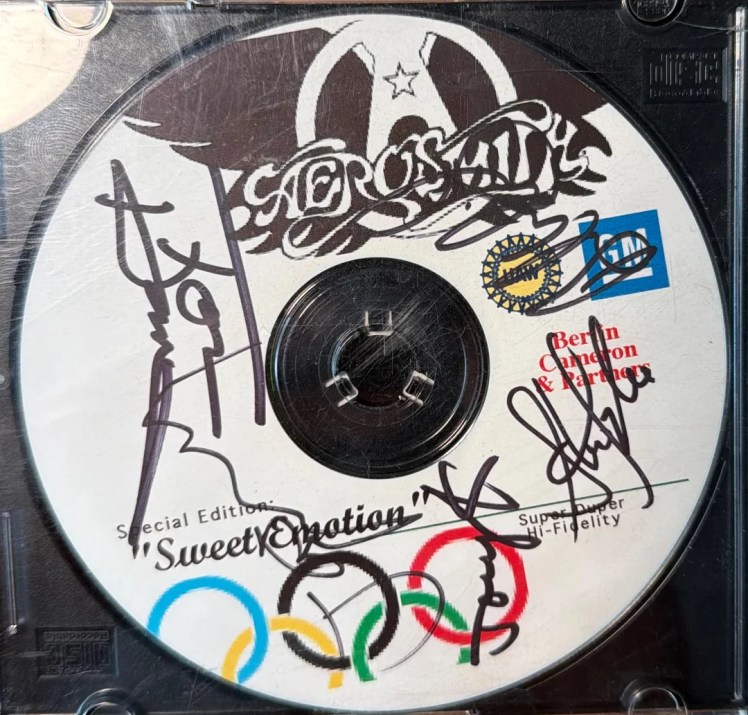
When the work was done, the band had CDs of the new recording made for the agency team and signed them. The discs were CD-Rs with a printed label reading “Special Edition: ‘Sweet Emotion'” and, as a joke, “Super Duper Hi-Fidelity”. The label carried the GM, UAW and Berlin Cameron & Partners logos above the Olympic rings. The signatures are in black marker across the face.
One of those discs surfaced in September 2026, when it was posted it on Reddit.
The 1999 reports support him. Tyler spoke of a new version, the Herald described a session with Douglas, and the first viewer to hear the spot noticed the heavier drums. A remake that stayed close to the 1975 arrangement was what the deal called for. GM wanted the song people knew, and the band needed a tape Sony did not own.


Looks like the OP of the Reddit post added an edit: they found a copy of the commercial!
https://vimeo.com/250224103
LikeLike