One month after the AC/DC concert that spawned their album’s title track, Aerosmith documented everything they had. The result — a reference cassette labelled “Aerosmith Demo Songs Tape 2/21/96 Tape 10+2” — is the most complete snapshot of the Nine Lives project at any single point during the Miami period. Where the earlier demo tape captured the raw portfolio Ballard inherited, this tape shows what happened next: a month of intensive development at the Marlin Hotel, new songs written, old demos refined, and Tyler stamping his voice onto tracks that had previously carried Marti Frederiksen’s guide vocals.
Client: Sony Music | Producer: Glen Ballard | Engineer: Chris Fogel | Assistant Engineer: Shad T. Scott
The “10+2” likely refers to the tape’s number in an ongoing series, suggesting a systematic documentation process at South Beach Studios. The Sony credit confirms this was at least partly a progress report for the label — here is what we have, here is how far along we are. Twenty-two titles are listed across two sides. Most appear to have been recorded, though one known copy — reportedly once Tyler’s own — has a B-side that didn’t record properly, leaving a handful of later titles unheard on that particular cassette.
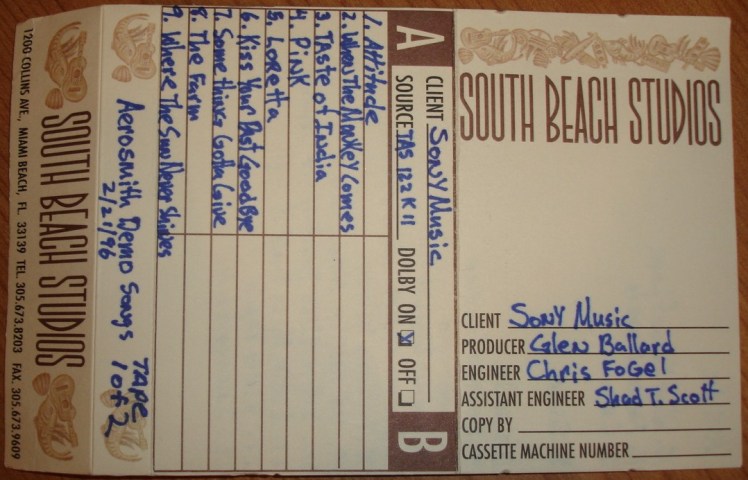
Side A
- Attitude — The Frederiksen co-write that appeared on the earlier demo tape in near-final form, with lyrics and structure already matching the released version. By this point likely folded into the Ballard production pipeline. The guitar solo from the demo would survive all the way to the finished album — Perry confirmed in Metal Edge that he flew it directly to the final record.
- When the Monkey Comes — A significant development from the earlier tape. On the Perry/Frederiksen DAT, this track had Frederiksen on guide vocal with mostly scatted lyrics and the word “disguise” repeated at the end. Here, Tyler has replaced the vocal with his own pass, adding alternate lyrics that were nearly complete but didn’t yet flow as well as the final version. The song would eventually be reworked into “Angel’s Eye” and released for the Charlie’s Angels soundtrack in 2000. Its presence confirms Tyler was actively mining the Frederiksen DAT demos and developing the ones he liked.
- Taste of India — Written at Ballard’s garage studio in LA during the fall 1995 writing road trip, when Tyler described sitting in “that little room where Alanis did her whole record.” By February, the track was likely further developed with Ballard’s production at the Marlin. The sarangi player and David Campbell’s orchestration noted by Perry in Guitar World (April 1997) came later.
- Pink — Still in demo form — the earlier tape had it as a bare acoustic shuffle with flanged effects where the solo would go. This version is the basis of what would become the “South Beach” mix, later released on the single and the 2002 compilation O, Yeah! Tyler told Metal Edge that the lyrics took four days to write.
- Loretta — A fast-paced pop/rocker with a slight punk feel, written during the South Beach sessions with Ballard. The version on this tape sounds more like a live improvisation take — rougher and less polished than the version that would appear on the June 1996 Ballard mix tape four months later, suggesting the song was still actively being shaped.
- Kiss Your Past Good-Bye — Present on the earlier demo tape with rough guitars and a completely different solo. Tyler wrote in his memoir that the song was “a premonition of the coming breakup” with Collins. One night at the Marlin, after hearing Tom Lord-Alge working on Sheryl Crow’s “If It Makes You Happy” in the basement studio, Tyler and Perry went upstairs and wrote it. This version likely represents a more developed pass than the earlier demo.
- Somethin’s Gotta Give — The Frederiksen track born from the first-week-of-January two-day session. On the earlier demo tape, it had 100% programmed drums with Frederiksen audibly ad-libbing chorus responses. The general structure remained intact from that first demo through to the final release.
- The Farm — One of the songs performed at the November 1995 club gigs but notably absent from the earlier demo tape. Its appearance here fills that gap. Tyler’s memoir describes the writing as a key creative moment; Ballard’s June 1996 mix would later suggest that Tyler’s vocals from the Miami sessions may have been kept for the final album while only the instruments were recut in New York.
- Where the Sun Never Shines — Like “When the Monkey Comes,” this track has been transformed since the Perry/Frederiksen DAT sessions. Frederiksen’s “Cheating Nights” guide vocal — with its placeholder lyrics and alternate chorus melodies — has been replaced by Tyler’s own performance. The leaked sample version that has been heard by fans is sourced from this tape. It is highly unlikely Aerosmith ever recorded a full-band version of the song.
- What Kind of Love — Another song performed at the November 1995 club gigs but absent from the earlier demo tape. Later retitled “What Kind of Love Are You On” and used on the Armageddon soundtrack (1998).
- Fallen Angels — Present on the earlier tape as a MIDI sketch with a single track of Perry’s electric guitar, alt lyrics, and extra second-verse sections. Likely more developed here, though still in need of the production work and structural edits that would come later.
- Crash — Present on the earlier tape with its drum machine, slide guitar, and handclaps. Tyler was already getting creative with recording the fast chorus vocals in the earlier version.
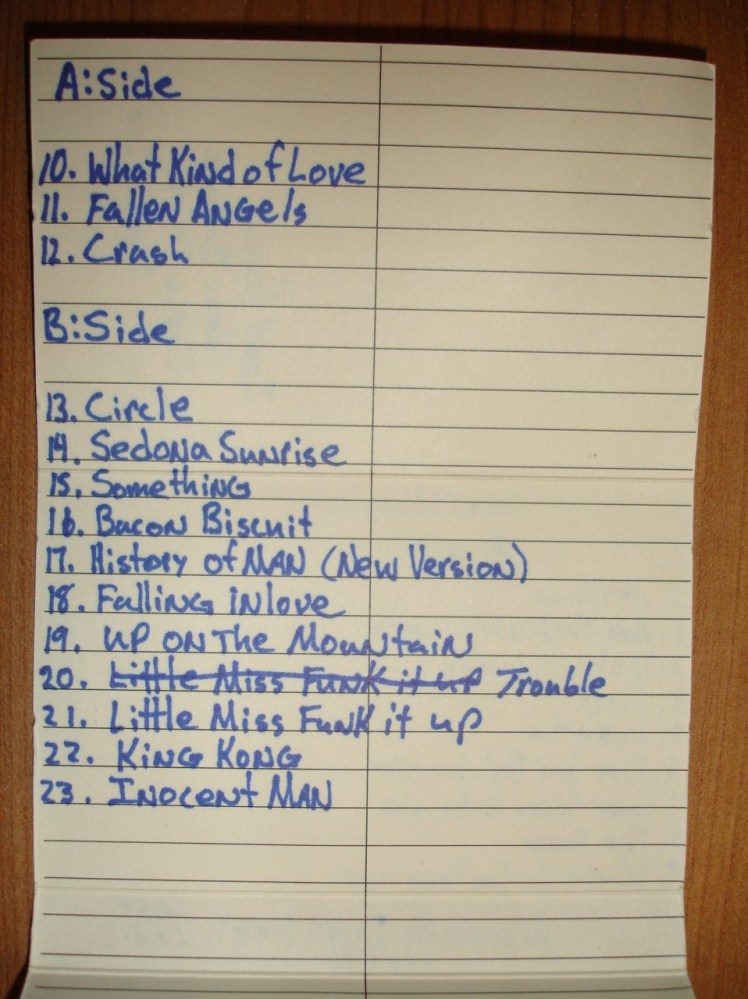
Side B
- Circle — “Full Circle,” written with Taylor Rhodes in Nashville. The earlier demo tape had it with heavy reverb, no harmony, and no key-change buildup for the final section — making it sound too repetitive. Kevin Shirley would later be the one to elevate the song’s dynamics for the 1997 release.
- Sedona Sunrise — Not a Nine Lives composition. A Pump-era (1989) outtake by Tyler/Perry/Jim Vallance, whose country flavour had kept it off that album. The band reportedly never recorded a new demo of it for Nine Lives but may have considered it for redevelopment, possibly adding overdubs or altering the mix from the original Pump sessions. A separate DAT dated 02/08/1996 contained a crystal-clear version of the demo. The song would eventually be released on the 2006 compilation Devil’s Got a New Disguise.
- Something — A Joe Perry song also performed at the November 1995 club gigs. Like several tracks from this period, it sat in the vault for over a decade before eventually being released on Aerosmith’s 2012 album Music from Another Dimension!
- Bacon Biscuit — A naughty and rauncy Richie Supa blues song that he pitched to the band from 1994. Would appear on the June 1996 Ballard mix tape as “Biscuit Boogie Blues.” It made it all the way to the end of the Miami production before being cut. Despite multiple studio versions and strong band interest, its evolving structure and changing arrangements likely kept it from a final release, leaving it as a well-known fan favourite.
- History of a Man (New Version) — Written by Pat Macdonald and Mark Hudson, brought to the band by Hudson and produced during the Miami sessions with Ballard. The “New Version” tag suggests an earlier version existed. Confirmed recorded but never surfaced in any form.
- Falling in Love — A more developed version than the earlier tape‘s LA garage demo. That version had the Cheshire Cat bridge lyrics and Perry’s guitars without proper tone. By February, the song was likely being refined under Ballard’s production at the Marlin — Ballard told Songfacts he wrote it “at the Marlin Hotel, Suite 205,” suggesting continued development beyond the initial LA demo.
- Up On the Mountain — A Tom Hamilton composition. Like “Something,” it sat unreleased for years before eventually appearing on Music from Another Dimension! (2012). No details are known about the state of the demo at this stage.
- Trouble — Written by Richie Supa in 1992 and performed at the November 1995 club gigs. Absent from the earlier demo tape. Musically, it blends heavy riffs, bluesy swagger and rough experimental structure, but its incomplete production, machine-loop drums and unfinished lyrics likely explain why it was ultimately left off both albums.
- Little Miss Funk It Up — True ghost. No information exists about this song beyond the title on the tape jacket.
- King Kong — True ghost. Like “Little Miss Funk It Up,” known only from the tape listing.
- Innocent Man — Also listed on the tape. Originally from the 1992 Get a Grip sessions, later reworked with Frederiksen. He confirmed its quality in the 2020 Masterclass: “It’s a full-on production, probably out there by now. It’s fully produced, just like that record, with strings, backgrounds and everything.”
What Changed from the Earlier Demo Tape
Comparing this tape to the earlier demo tape reveals a project in rapid expansion. The earlier tape had eleven tracks — all pre-producer, mostly drum-machine beds. This tape lists twenty-two titles, nearly doubling the catalogue in roughly a month.
- New songs that didn’t exist on the earlier tape: Nine of them — The Farm, What Kind of Love, Taste of India, When the Monkey Comes, Where the Sun Never Shines, Loretta, Bacon Biscuit, Something, Trouble, Sedona Sunrise (from Pump), Innocent Man (from Get a Grip), and History of a Man (Hudson/Macdonald). Also absent: “Nine Lives” the song, written after the 21 January AC/DC show but apparently not yet demoed in a form ready for this reference tape — despite the tape being dated exactly one month later.
- Tyler replacing Frederiksen’s vocals: At least two DAT-origin tracks — “Where the Sun Never Shines” and “When the Monkey Comes” — now carry Tyler’s voice instead of Frederiksen’s guide vocals. This confirms Tyler was actively listening to the Perry/Frederiksen demos and developing the ones he wanted.
- Songs still absent: “Hole in My Soul” and “Ain’t That a Bitch” — the two Desmond Child songs from the summer 1995 Florida vacation — are nowhere on this tape. Ballard had opted to take the album in a different direction, and these songs sat unattended. It would take Child’s back-door hustle at Criteria two months later to rescue them.
The Tape’s Significance
This is the project at its most ambitious and optimistic. Twenty-two titles under consideration, new material flowing, Ballard formally in place, Tyler writing lyrics at a furious pace. The crises that would define Nine Lives — Kramer’s breakdown, the Ferrone sessions, the letter, the exile, the rejection — were all still ahead. What the tape captures is the brief window when the album could have been anything: a sprawling double record, a tight twelve-track rock album, or the experimental loop-driven project Tyler dreamed of.
Within four months, Sony would listen to Ballard’s mixes and sit in silence. But on 21 February 1996, the silence hadn’t fallen yet. The songs were still growing.
Sources: South Beach Studios reference tape (2/21/96); Guitar World (April 1997); Metal Edge (June 1997); Steven Tyler, Does the Noise in My Head Bother You? (2011); Joe Perry, Rocks (2014); Glen Ballard, Songfacts interview; Marti Frederiksen, Rock ‘n’ Roll Fantasy Camp Masterclass (2020); AerosmithBackBurner.com.
 The Back-Burner: Aerosmith Outtakes & Demos