The first Aerosmith album is one of the most important debut records in American rock, yet for a long time it seemed unlikely that it would ever receive the kind of deep remix treatment later albums often get. The reason traces back to a story that began circulating in the late 2000s, when the band revisited their earliest material during the production of Guitar Hero: Aerosmith.

In 2007, Aerosmith returned to the studio to re-record several early songs so they could appear in the game, which eventually came out in 2008. Around that time, the explanation given publicly was that the original multitrack masters from the debut album were believed to be lost. One widely quoted report from 2008 explained the situation bluntly: “Because master tapes of the band’s debut album have been lost,” the band had to record new versions of tracks like “Dream On” and “Mama Kin” for the game. That line stuck with fans for years because it seemed to close the door on one of the most intriguing possibilities in the band’s catalogue: a proper remix of the first Aerosmith record.
If the masters were gone, the logic was simple. You could remaster the stereo album all day long, but you could never truly remix it.
That is what makes the events of the last couple of years so interesting.
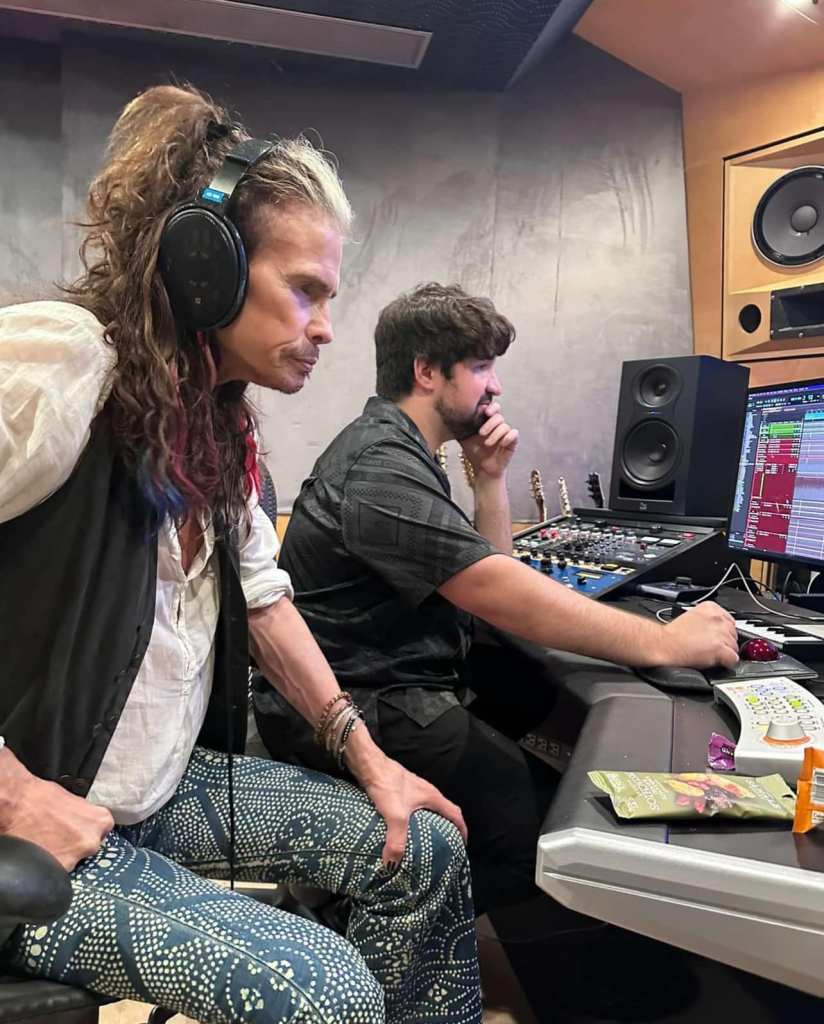
On November 29, 2023, Steven Tyler posted a photo of himself in a studio listening environment and wrote: “THROATS ON THE MEND… BUT MY EARS STILL WORK! SO IN THE MEANTIME… IT’S STUDIO TIME… STARTING RE-MIXING AEROSMITH AEROSMITH!” At the time it was easy to read it as a casual studio update while the band’s touring plans were on hold. But in hindsight the message looks like the first public hint of something much larger. If a remix was truly underway, it implied that the earlier story about missing masters had either changed, been partially resolved, or been worked around through newer techniques. Whatever the technical explanation, it was clear that something involving the source material of the 1973 album was happening behind the scenes.
The liner notes for the Legendary Edition, written by Rick Florino, now shed real light on that mystery. The original 16-track tapes were not simply sitting in a vault waiting to be pulled out. According to the notes, Tyler, Perry, and producer Steve Berkowitz — who is credited with Research and Development on the release — dug through “the original tapes (found and sourced by all manner of digging, backdoor deals, and the kind of cunning any Boston guy worth his salt is capable of).” That language is deliberately colourful, but it confirms what many fans suspected: the tapes were not gone forever, but they were not easily accessible either. Recovering them required serious detective work and back-channel negotiation.
And with the tapes in hand, the remix could begin. The person brought in to do it was Zakk Cervini, a producer and mixer born in 1993 in Connecticut, who worked alongside Tyler, Perry, and Berkowitz at MDDN Studios, with Julian Gargiulo as mix assistant and engineer. Understanding what this remix means requires distinguishing it from a remaster. A remaster works from the finished stereo master: it can improve clarity and balance, but the songs remain exactly the same mixes released in 1973. A remix goes back to the multitrack sources and rebuilds the songs from their individual parts, allowing guitars, drums and vocals to be repositioned, rebalanced and revealed with a level of detail buried in the original mix. For a record that has always sounded raw and somewhat compressed compared with later Aerosmith releases, that distinction matters enormously.
Tyler’s frustration with the original mix runs deep. His view is that in 1972 and 1973, nobody in the room fully understood what the band was trying to be. “Back then, I knew what we were going for, but they didn’t know who they were mixing and what we were about,” he says. “Fuck, we didn’t entirely know either — or even how to say it.” On Cervini, he is emphatic: “He leaves everything on the tape. You hear people talking to each other. When Joe stomps on the stomp box, you hear the button click.” His reaction to hearing the results was emotional: “When I heard this version, it honestly made me cry. I wanted our debut to sound the way it does now for the last fifty years.” The final mastering was handled by Chris Athens at Chris Athens Masters in Austin, Texas.
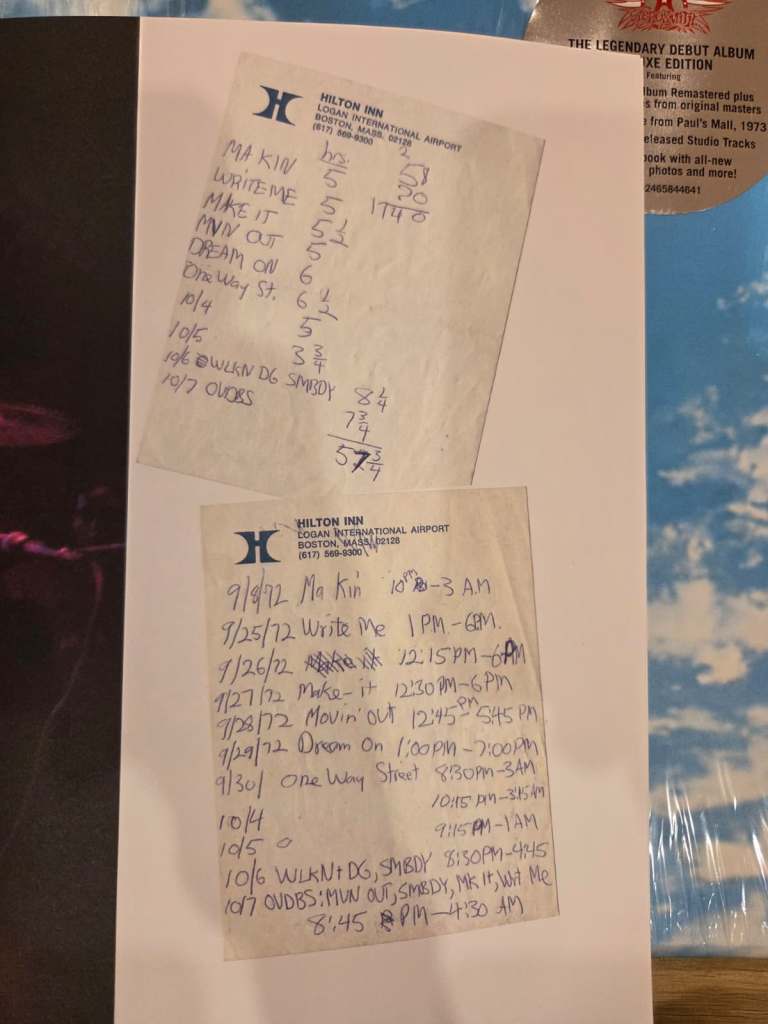
Those tapes the team dug up tell their own story. The session logs reproduced in the packaging reveal that the band entered Intermedia Studios at 331 Newbury Street in Boston earlier than previously stated. The liner note text says “October 1972,” but the earliest dated entry is September 9, 1972, for “Mama Kin,” recorded in a five-hour evening session from 10 PM to 3 AM. From there the schedule was relentless: “Write Me A Letter” on September 25 (1 PM to 6 PM, five hours), followed the next day by what appears to have been additional overdub or continuation work on the same song or other early tracks (12:15 PM to 6 PM, five hours and forty-five minutes). “Make It” was tracked on September 27 (12:30 PM to 6 PM, five and a half hours), “Movin’ Out” on the 28th (12:45 PM to 5:45 PM, five hours), “Dream On” on the 29th (1 PM to 7 PM, six hours), and “One Way Street” on the 30th in an overnight session (8:30 PM to 3 AM, six and a half hours).
After a few days’ break, they returned for “Woman of the World” on October 4 (10:15 PM to 3:15 AM, five hours) and “Major Barbara” on October 5 (9:15 PM to 1 AM, three hours and forty-five minutes). On October 6, “Walkin’ The Dog” and “Somebody” were cut together in the longest session of the run (8:30 PM to 4:45 AM, eight and a quarter hours), and on October 7 a final overdub session covered “Movin’ Out,” “Somebody,” “Make It,” and “Write Me” (8:45 PM to 4:30 AM, seven hours and forty-five minutes). The official total logged in the session documents comes to 57 and three-quarter hours, excluding the crossed-out September 26 date. Including it, the band spent roughly 63 and a half hours at Intermedia — an extraordinarily fast turnaround for a full album, and a direct consequence of having played these songs live for roughly a year before entering the studio.
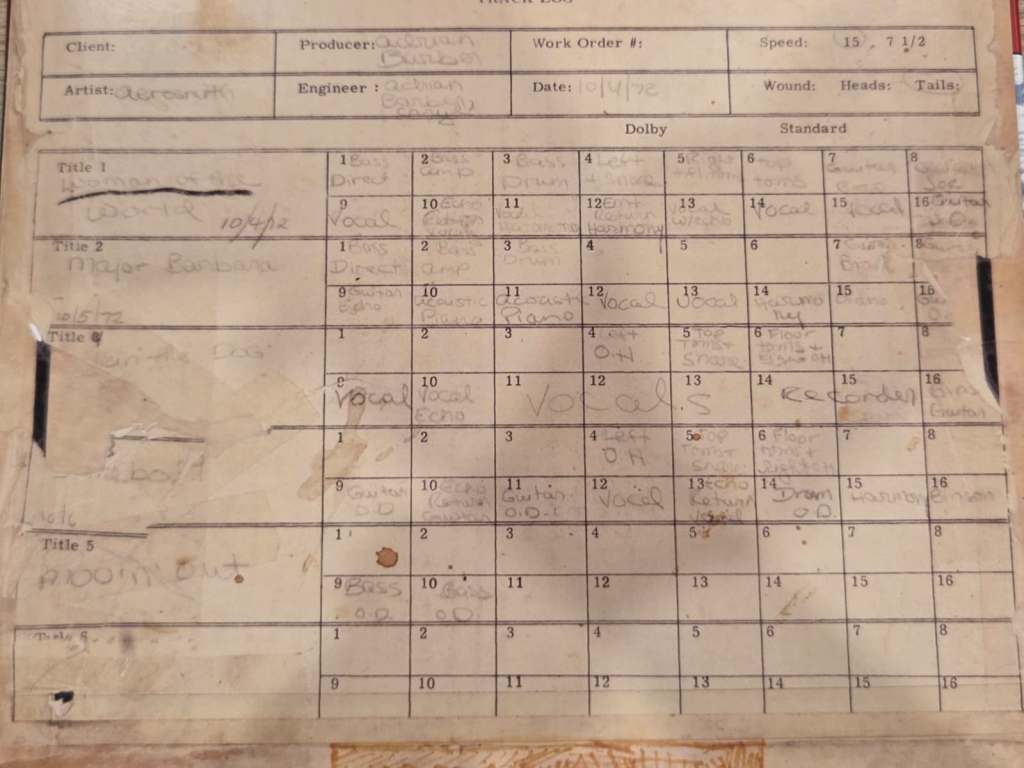
The track sheets show how the 16 tracks were typically allocated: four for drums, one for bass, two for electric guitars (one each for Perry and Whitford), and the rest split across vocals, overdubs, and effects returns. Depending on the song, entries appear for mellotron, maracas, phase shifter, harmonica, recorder, acoustic piano, organ, and keys. Perry had only “one or two guitars” at the time. Overdubs were minimal, squeezed into that single late-night session on October 7. Whitford remembers the band eventually disconnecting the recording light because they played better when they didn’t know tape was rolling. They called it “Red Light Blues.”
Neither “Woman of the World” nor “Major Barbara” appears on the Legendary Edition, despite having been recorded at these same sessions. “Woman” eventually surfaced on Aerosmith’s second album, Get Your Wings (1974), which makes its absence here suggestive and may be held back for a future deluxe edition of that record. “Barbara” surfaced as a bonus studio track on “Classics Live!”. If “Legendary Edition” is the beginning of a deeper catalogue project, these October 1972 recordings would be natural centrepieces for follow-up reissue.
The third disc opens with the famous Live at Paul’s Mall recording from March 20, 1973, a WBCN broadcast sourced from an original quarter-inch analog two-track tape courtesy of the David Bieber Archives, with transfers by Carl Plaster. That recording deserves its own discussion, and it will get one separately.
The rest of the bonus material is where things get especially interesting. The disc includes alternate and rehearsal versions of “Make It” and “Write Me A Letter,” a session take of “Train Kept A Rollin’,” and two jam-oriented pieces: “Harmonica Bass Jam Jelly” and “Joined At The Hip (Aerojam).” The liner notes describe “Harmonica Bass Jam Jelly” as capturing “the creative conversation between Tyler and Hamilton.” One of the track sheets in the packaging shows a curious entry with harmonica and bass spread across multiple tracks and relatively few other instruments — possibly the source recording for this piece. The alternates of “Make It” and “Write Me A Letter” should give a glimpse into how the band refined arrangements in the studio, with the “Make It” variations allowing listeners to hear the song Tyler famously wrote on a tissue box during the drive into Boston from every angle (perhaps both tracked in the scrapped September 26 session).
But “Joined At The Hip” is the centrepiece. At nearly six minutes, the liner notes describe it as a “recently uncovered jam” that finds the band running through riffs, licks, and solos anchored by Kramer’s drumming. The connection to “Sweet Emotion” that early descriptions hinted at is now confirmed explicitly. According to the notes, it is the recognizable bridge of “Sweet Emotion” that ushers the instrumental along. Tyler is unequivocal: “That was fucking four years before we actually did ‘Sweet Emotion.’ We were joined at the hip at the time. This is where it all started.”
That four-year gap matters. “Sweet Emotion” appeared on Toys in the Attic in 1975. Hearing its DNA in a jam from the debut era rewrites part of the timeline, suggesting the core musical idea existed in embryonic form far earlier than anyone knew.
There is also the question of where “Joined At The Hip” actually comes from. It does not map neatly onto the documented Intermedia session logs. The liner notes open with a vivid account of the band rehearsing in the Boston Garden’s locker rooms during the summer of 1972, jamming for hours while professional wrestlers like Killer Kowalski and Haystacks Calhoun prepared for their matches nearby. That places intensive full-band rehearsals several months before the Intermedia sessions began. For years, collectors have whispered about stray Aerosmith rehearsal reels from around 1972 that circulated privately, with one story suggesting a reel was returned to Joe Perry by a collector decades later. The description of “Joined At The Hip” as “recently uncovered,” combined with the liner notes’ broader language about tapes recovered through “backdoor deals,” is consistent with material that originated outside the main studio archive. If any track on the Legendary Edition feels like it might have travelled through the shadows of the collecting world before reaching an official release, it would be this one.
One final timing detail is worth noting. The liner notes refer to the project as the “50th Anniversary Edition,” and the internal credits point to a 2025 production timeline. But the Legendary Edition was not announced until early 2026. The most likely explanation is that the remix work began in late 2023 and continued through 2024, with the boxset design and promotional cycle targeting a 2025 release, before the “One More Time” sessions with Yungblud in May and June of 2025 introduced a sense of urgency to get that material out first. The boxset was pushed back accordingly.
Whatever the timeline, what once seemed like a closed chapter has suddenly reopened. The existence of documented but unreleased recording of “Woman of the World,” along with whatever was tracked during the crossed-out September 26 session, suggests that more material from this era survives than has been released here. As Tyler puts it: “Now, I can’t wait to see what happens with it.”
 The Back-Burner: Aerosmith Outtakes & Demos
2 thoughts on “Aerosmith’s Legendary Edition: from “lost masters” to a 2024 remix, a famous Paul’s Mall tape, and one very intriguing Aerojam”