After the success of Permanent Vacations and Pump, Aerosmith manager of the time, Tim Collins, thought it would be a good idea to record the writing and recording process of their follow up album. The project was conceived as a follow-up to The Making of Pump (1989), with the same kind of release path in mind: MTV special, home video, or sale to the highest bidder. It was never finished.
The day-to-day videographer hired for the project was Peter Martinez, a Boston-trained director and editor brought in by Keith Garde, head of creative services at Collins Management. Collins’s office leased him a Sony Beta SP broadcast camera and put him on what would become a roughly three-year embed with the band, capturing the writing sessions, the recording, the label meetings, the video shoots, and the early days of the 1993 tour. Other team members likely cycled in for specific shoots and post-production work, with the tape archive itself stored and dubbed at Editel Boston, but Peter was the constant.
Footage was captured at Steven Tyler’s home studio, Joe Perry’s basement Boneyard, Longview Farm, Desmond Child’s Miami studio (where the band worked on the first verse of “Crazy”), A&M Studios in Hollywood during the LA recording phase, and Bruce Fairbairn’s Little Mountain Sound in Vancouver. Beyond the studios, Peter also got into rooms an outside crew never would have: John Kalodner’s office at Geffen Records, Tommy Mottola’s office at Columbia Records during the Sony deal negotiations, and the Wang Center stage on October 13, 1991, the night Steven Tyler descended from the rafters on a grand piano during the MTV 10th Anniversary Special with Michael Kamen and a 57-piece orchestra. Peter was crouched directly underneath the piano as it swung out, and per his 2026 interview with the Back-Burner the descent was shot six or seven times, with the audience pretending each take was the first.
The auction lot dates (June 12, 1991 to March 25, 1992) only cover the LA-era recording window. Per Peter himself, he was filming earlier than the first dated tape and continued past the last, into Vancouver in late 1992 and through 1993 tour and video shoots. The full archive is substantially larger than what surfaced publicly.
The Tommy Mottola office, August 1991
One of the more cinematic rooms in the archive is Tommy Mottola’s office at Columbia, where Aerosmith’s return to Sony was secured against incredible odds. Per Peter: “Tommy had this office, it was this super crazy long kind of narrow office that his desk sat at the end of. He had a fireplace on the sidewall that he could kind of control with like, a button, to make it kind of like the Wizard of Oz a little bit. And he also had a button on his desk that would slam the door as people walked in or out. There was a lot of very last-minute kind of wrangling and people getting mad and people kind of storming out and coming back in. At the end of the day, they got it done.”
The Sony deal was announced in Rolling Stone on October 3, 1991. The formal $30 million signing came later, and per Joe Perry’s autobiography Rocks there was a second tense moment at the actual signing when Tim Collins pulled the band into a conference room five minutes before the contract went down and demanded his commissions be paid up front. Peter’s footage may cover both meetings.
The Kalodner playback, March 1992
The most consequential single piece of footage in the archive has never publicly surfaced. By mid-March 1992, Bruce Fairbairn had assembled what was at that point a sixteen-song LA album, which Don Henley signed off on across Bruce’s wall chart on March 6 while recording backing vocals on “Amazing.” Somewhere in the next two weeks, John Kalodner came down from England (he’d been working on a Jimmy Page solo album) to listen to it. Peter was in the room.
Per Peter in 2026: “Bruce is playing through all the tracks for him, and John’s just, he has his eyes closed, listening intently. And Steven’s nervous the way he would always be in a situation like that, because it’s like his kid, you know, he doesn’t want anything bad said about it. Then at the end of it, John said, ‘I don’t hear it. I don’t hear the hits. We need to do more work.'”
Joe Perry remembered the same moment in his 2014 memoir as: “I don’t hear a single.” Two independent eyewitness accounts of the same sentence, thirty-plus years apart. That sentence killed what would have been the LA version of Get a Grip, sent the band to the Boneyard for the summer to bring in outside writers like Mark Hudson, Lenny Kravitz, Taylor Rhodes, Jack Blades and Tommy Shaw, and ended the documentary in its tracks. Per Peter: “The whole thing went on hold when the plug got pulled on the album.”
The Eat the Rich video
The most-watched piece of Peter’s work was the Eat the Rich music video itself, which aired on MTV in June 1993. Marty Callner had directed the album’s first single, “Livin’ on the Edge,” earlier that spring at a cost of around $400,000. A money dispute had followed. When it came time to make the next video, Tim Collins handed the project to Keith Garde and Peter Martinez with a $16,000 budget and the existing documentary archive to draw from.
Per Collins in his 1997 interview with Larry Katz for the Boston Herald: “Callner had made a video, it was huge, then we had to fight over money, and I brought somebody else in. So what I did is I got Keith Garde, who was the head of creative services. And he pulled out all the footage we had filmed, the making-of footage. Keith went in the studio with a local guy named Peter Martinez, and they made this incredible video for 16 grand. This other video cost 400,000. And the video for 16 grand got a better response than the $400,000 video, because Keith knew the essence of Aerosmith.”
Per Peter’s own version in 2026, the Eat the Rich video was about 25% archival footage from the existing documentary archive and 75% new material shot in a single day at Soundtrack Studios in Boston, with each band member filmed one at a time. Wayne Maser NYC photo-shoot stills were also incorporated. The cameos, John Kalodner with his famous beard, comedian Anthony Clark, WBCN DJ Mark Parenteau, all came from Peter’s day-one Boston shoot. The video cost roughly 4% of the Livin’ on the Edge budget and, per Collins, outperformed it.
The tapes today
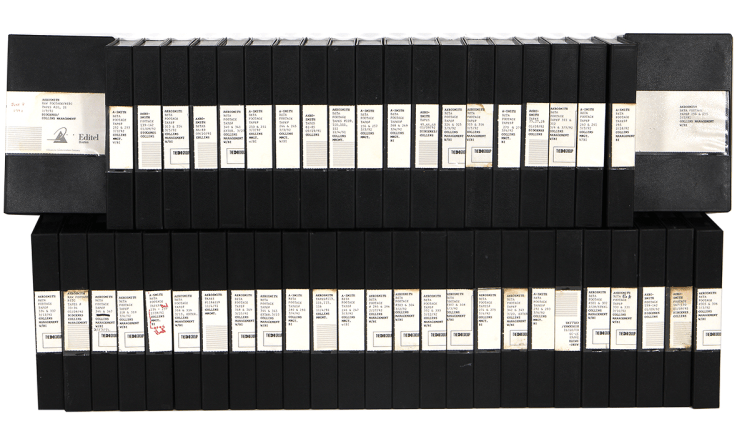
In April 2022, the auction house GottaHaveRockAndRoll posted an Aerosmith Collection of 45 Beta Tapes of never before seen footage from this project. This represented 50+ hours of unedited material of the band working, private conversations about the making of the album, and tour. The auction did not include ownership rights to make duplicate copies of the material on these tapes for resale. The public bid ended at $5K on 4/30/2022.
Most of the auctioned footage carried a visible burned-in timecode, which suggests this was a working copy made for an editor to log footage and make cut decisions, not the broadcast-quality master Beta SPs that Peter actually shot. Per Peter: “All those tapes were originally stored at a place called Editel, in Boston. They had a big storage room down there with all these rolling racks that they did their tape storage. As the tapes would get shot, they would always immediately make a copy of each tape with the burn-in time code on it for people to look at and decide whether or not they wanted to do something with it.” The masters, then, are still somewhere, separate from the dubs that surfaced at auction. Editel was sold to Unitel, until it went out of business in 1999. What happened to the tapes in their Boston office is unknown.
One other detail worth noting: no work-for-hire agreement was signed on the documentary footage at the time of production. Under standard copyright law that gives the videographer an individual claim to the material alongside everyone else with an interest in it (the band, the songs, Sony, the descendant Collins Management apparatus).
A future for the footage
In March 2026, Aerosmith released the Legendary Edition of their 1973 debut, establishing a model for revisiting catalogue with modern tools and previously-unreleased material. The 2027 Nine Lives thirtieth anniversary will likely produce something similar. The 2028 Get a Grip thirty-fifth anniversary would be the logical next step, and Peter’s archive sits at the heart of any such project. Permanent Vacation and Pump both had companion making-of films. Get a Grip never did. The pieces of a real project are, in theory, all on the table.
Should the band take action and give the footage to a film studio to produce a project similar to Diney+ The Beatles: Get Back?
6/12/1991 – Tapes #20–21 – Raw footage
6/12/1991 – Tapes #25, 27, 28 – Steven Tyler getting hair styled for possible video
1/09/1992 – Tapes #159–162 – Aerosmith in studio rehearsing; Steven Tyler, Joe Perry, Bruce Fairbairn
2/28/1992 – Tapes #236–237 – Studio footage; “Joe’s Bed”
3/03/1992 – Tapes #240–241 – Studio footage
3/03/1992 – Tapes #246–247 – Studio footage
3/03/1992 – Tapes #250–251 – Studio footage
3/03/1992 – Tapes #252–253 – Studio footage
3/03/1992 – Tapes #256–257 – Studio footage
3/04/1992 – Tapes #268–269 – Members rehearsing and discussing songs for 1993 album with Bruce Fairbairn & Tim Collins
3/04/1992 – Tapes #270–271 – Studio footage
3/04/1992 – Tapes #274–275 – Studio footage
3/04/1992 – Tapes #280–281 – Studio footage
3/04/1992 – Tapes #292–293 – Studio footage
3/04–05/1992 – Tapes #311–312 – Studio / rehearsal sessions
3/05/1992 – Tapes #313–314 – Studio / rehearsal sessions
3/06/1992 – Tapes #318–319 – Studio / rehearsal sessions
3/09/1992 – Tapes #324–325 – Studio / rehearsal sessions
3/13/1992 – Tapes #338–339 – Exterior footage (Hollywood)
3/20/1992 – Tapes #340–341 – Exterior footage (Hollywood)
3/23/1992 – Tapes #344–345 – Exterior footage (Hollywood)
3/25/1992 – Tapes #348–349 – Driving around Hollywood; Joe Perry practicing electric guitar in studio
 The Back-Burner: Aerosmith Outtakes & Demos
I’m the guy that followed them around and shot all of that footage. I shot them writing the tracks at Steven’s home studio, Desmond Child’s Miami studio, Longview Farms and a number of locations around LA. I shot all of the recording sessions at the old A&M studios on LaBrea in Hollywood and shot some of the additional work they did at Bruce FairBairn’s studio in Vancouver. I also shot behind the scenes of the at the Wang Center in Boston for their live Dream On performance in 1991 with Michael Kamen and a full orchestra on stage with them. When Steven got lowered down from the rafters playing a grand piano that was floating on a small platform suspended by impossibly thin wires, I was tucked in on the side of the stage with my camera and was more than a little nervous as the the whole rig passed right over me. I shot in legendary A&R man John Kalodner’s office at Geffen Records for meetings with Collins Management and the band and I was shooting in Tommy Mottola’s office as some contentious last minute midnight negotiations threatened to scuttle but then finalized their exit from Geffen and their return to their return to their original home at Columbia Records.
I grew up in the 70’s in Cleveland getting stoned and listening to Get Your Wings, Toys In The Attic and Rocks in my buddy’s garage. I never could have imagined then where life would take me 15 years later. The tapes surfaced at that auction are just a small fraction of the footage I shot.
LikeLiked by 1 person
Fascinating story Peter, thanks for sharing. I can only imagine growing up as a fan and then following the band around as they write new hits must have been like, amazing experience indeed. Would you know what happened to the project? why it never came to be? the footage must be incredible to watch, the inception of their hit songs, but also the reasoning behind each of the chosen words, etc, plus I’m guessing rehersals and unreleased songs in the works as well. I’ll reach out via email 😉
LikeLiked by 1 person
Feel free to email me. I’m curious about the source of the auction.
Peter
LikeLike
Were the rehearsals and outtakes from the Wang Center (MTV 10) recorded?
I would love to see and hear them.
LikeLiked by 1 person
I shot some creative meetings at the Wang Center with Michael Kamen and the band but they were so road hardened by then that they didn’t need much rehearsal. That being said, once the audience was brought in and the orchestra on the stage and Steven up in the rafters they did somewhere between 5 – 8 passes through the song to make sure they had it covered for the video.
LikeLiked by 2 people
This is fascinating, Peter! I’m currently working on a project about Aerosmith I’d love to speak with you about the filming of the Get A Grip documentary. My email is andrew@voyager.tv – thank you!
LikeLike
I think you can reach him at petermartineznyc: traffikfilms@mac.com
LikeLike