This is the tape that killed the Miami album.
Dated 26 June 1996, the Glen Ballard mix tape is the closest thing that exists to the lost Nine Lives — eighteen productions spanning the full scope of the South Beach and Criteria sessions, plus two earlier tracks from May. It was assembled during the seven weeks Tyler was exiled from the studio, after Collins’s confrontational letter and the call to Tyler’s wife Teresa had detonated the band’s internal dynamics. Collins had sent Ballard a cease-and-desist letter and ordered him to keep Tyler out of the studio. Ballard mixed alone.
Tyler would spend years arguing that the album was never finished — that Sony judged a work in progress, mixed without the songwriter present. As he told a radio interviewer: “You’re not going to get a good rendition of anything Aerosmith does unless one of the guys who wrote the song is in the studio to mix it.” And to Larry Katz in the Boston Herald (June 1997): “No album would have ever been good if I didn’t get in there and mix it with a producer.”
The tape confirms both Tyler’s frustration and Sony’s concern. Tyler’s vocals are often magnificent — complete, committed, sometimes better than what ended up on the released album. But the guitar parts are frequently incomplete, the drums are largely electronic, and the band as a five-piece unit is barely audible. When the Sony executives flew to Miami for the listening party, Perry described the aftermath in Rocks: “After the last song, dead silence. The silence lasted an uncomfortable thirty seconds.”
We don’t know for certain whether this specific tape is what Sony heard that day, but it aligns with everything we know — and it tells the story of an album that was still very much a work in progress, prejudged before it had a chance to be completed.
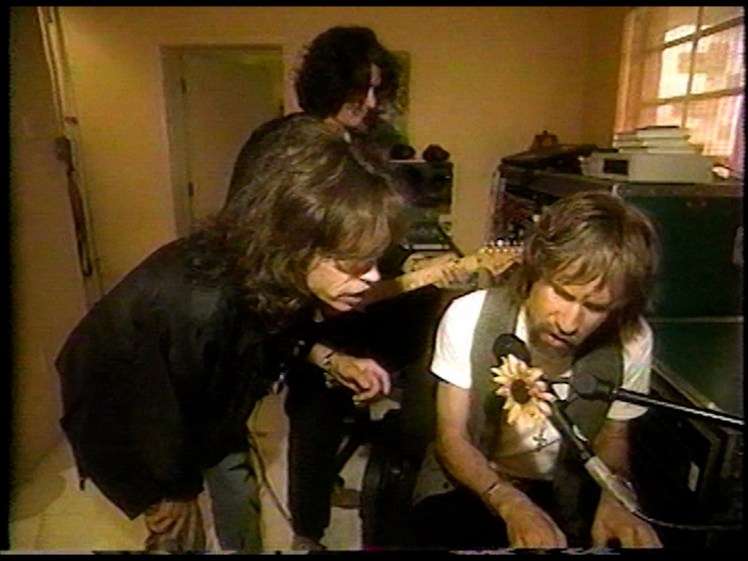
Two tracks at the front of the tape predate the June mixes by over a month, offering a snapshot of the production in mid-May — around the time MTV visited the band at Criteria Studios.
- Falling in Love — Nicole Mix (5/18/96) — An earlier mix of the lead single, named for someone likely involved in the session. Additional alternate mixes of “Falling in Love” are known to exist on associated tapes from this period, including a Dance Mix (6/26/96), an Extended Mix, and two versions labelled “Moby Flawed Mix” and “Moby Fucked Mix” — suggesting Columbia was already preparing single formats even before the album was approved.
- Heart of Passion — Demo (5/18/96) — A gentle, drumless ballad written by Tyler and Richie Supa (registered with ASCAP under the alternate title “Throws of Emotion”). The demo features synth keyboards, soft percussion bongos during the chorus, a click track, and a distorted guitar — clearly a work in progress. Tyler’s vocals are the predominant instrument, hitting outstandingly high notes in the chorus. The song feels more like a Tyler solo pop track than an Aerosmith record. It was never developed beyond this demo stage.
- Falling in Love (6/26/96) — The final Ballard mix, and perhaps the most developed track on the entire tape. The Cheshire Cat bridge lyrics from the 1995 garage demo have been removed. A bright horn section has been added. More stereo-panned guitar work from Perry fills the verses. Of all the tracks here, this one had the most overdub work done — horns, refined guitar parts, structural edits — suggesting it was being groomed as the lead single from early on.
- Taste of India (6/26/96) — Includes a little extra sarangi intro. Otherwise the content is mostly identical to the “Miami Madness Mix” that has essentially been released — same Tyler whispers panned left during verse one and right during verse two, same background effects and vocal arrangement. The mix is slightly different. The ending feels incomplete, missing a Perry guitar solo — it’s just a long extended jam that trails off. The drums sound like an electric drum kit rather than a programmed machine. Of all the tracks, this one was closest to its final form, though the sarangi player and David Campbell’s orchestration noted by Perry in Guitar World (April 1997) would be refined further.
- Pink (6/26/96) — The South Beach mix. Same programmed snare on the intro. Fundamentally the same recording that would later be sent to radio as the “Florida Version” and included on the 2002 compilation O, Yeah! — though that version brought the background vocals and opening harmonica solo more to the front of the mix. Here everything is somewhat squashed. The demo that started as an almost hilariously simple acoustic shuffle had been refined but not fundamentally reinvented — proof that some songs arrive nearly complete.
- Loretta (6/26/96) — A fast-paced pop/rocker with a slight punk feel and Beatles-influenced lyrics and melodic sensibility — the title character likely inspired by the “Get Back” lyric “Sweet Loretta Martin thought she was a woman, but she was another man.” Tyler’s lyrics tell the story of a transgender drug-addicted character in typically vivid Aerosmith fashion. The February reference tape had a rougher, live-improvisation-sounding version; this is the more polished Ballard production. The drums sound like they could be a live drummer — unclear whether Ferrone or Kramer replacing his parts. The song made it all the way to the final selection process before being cut. Never released.
- The Farm (6/26/96) — Closer to the final released version than most tracks on the tape. Raw Wizard of Oz dialogue sample. An extra “he did” at the end before Tyler sings “take me to the farm.” The intro drum fill is real, but the body of the song is a drum machine with live drum elements layered underneath — a sampled snare doubled over programmed beats, possibly a real kick in spots. Most notably, Tyler’s vocals sound like the same performances that appeared on the 1997 release — suggesting that when the band recut the album in New York with Shirley, they may have kept the original Miami vocal and only replaced the instruments around it.
- Kiss Your Past Goodbye (6/26/96) — Softer Tyler vocal on the intro than the earlier demo. The electronic drums feel closer to what Ballard did with Alanis Morissette — busy, rhythmically intricate, but not organic. No outro guitar solo from Perry. Tyler’s long scream is buried deeper in the mix. The overall feel is polished but missing the raw edge.
- Nine Lives (6/26/96) — Born from the “Whole Lotta Rosie” jam after the 21 January AC/DC show, but sounding very different from the released version. No intro guitars — just drum and bass. Definitely a drum machine. Slide guitar solos mimic the vocal chorus melody — an interesting texture largely absent from the Shirley version. Missing a couple of lyric lines. Short outro. The main solo is completely different. A fascinating alternate vision of what became a straightforward rocker.
- Fall Together (6/26/96) — A Tyler/Grakal/Hudson composition that would later be cut from the album tracklist, devastating Tyler. “I was really pissed that it’s not on there,” he told Metal Edge. “I love it too; I think it’s one of the best songs on the album.” It survived only as a Japanese bonus track and a B-side.
- What Kind of Love You Want (6/26/96) — Later retitled “What Kind of Love Are You On” and used on the Armageddon soundtrack (1998). A song performed at the November 1995 club gigs that had been developing throughout the Miami period. This version includes additional lyrics in the lead-up to the solo during the second chorus, with Tyler possibly ad-libbing lines “Too bad, so sad, but you’re so happy when you’re getting them all. What kind of love are you on? Is that the reason that you’re falling apart? Ain’t no wonder that your kink got lost. Your I as a whole stays sober, but your speaking is getting worse. What kind of love are you on? You better talk like you’re top of the chain…” freewheeling vocal improvisations that were later trimmed.
- Something’s Gotta Give (6/26/96) — The Frederiksen track born from the first-week-of-January two-day session, now in its Ballard-produced form. The song that started as “a freight train” demo with programmed drums and Frederiksen’s ad-libs, refined across the Miami sessions.
- Biscuit Boogie Blues (6/26/96) — Originally written by Richie Supa in 1994 and offered to the band under the name “Baking Biscuit Blues” along with two other blues demos. Tyler and Perry worked on it during the South Beach sessions; it appeared on the February tape as “Bacon Biscuit.” A food-metaphor-laden blues — “put your biscuits in the oven, honey, watch my dumpling rise” — that made it all the way through the selection process for both the Ballard and possibly the Shirley sessions before being cut. The band played it live regularly during the 1997–98 tour, and Tyler kept teasing lines from it in radio interviews for years.
- Ain’t That a Bitch — Version 1 (6/26/96) — The original Desmond Child demo from the summer 1995 Florida sessions, essentially unchanged. The same polished recording heard on the earlier demo tape — organ, female backing vocals, guitar solo close to the released version. It sat unattended throughout the Marlin sessions until Child hustled his way into Criteria to rescue it.
- Ain’t That a Bitch — Version 2 (6/26/96) — The refined Miami production, likely tracked at Criteria after Child’s back-door intervention in April–May 1996. This is the version that “finally came out right,” as Perry put it in Guitar World (April 1997), after three attempts at the title across the Get a Grip era, the 1995 Child sessions, and this last-minute Miami recording.
- Bridges Are Burning — Final Mix (6/26/96) — A pop-rock song written by Tyler, Perry, and Marti Frederiksen during the South Beach sessions. The song starts directly into the verse with full-on distortion and wah-wah guitars. Drums feature great fills — they sound like they could be live, though it’s unclear whether Ferrone or Kramer played them. Tyler works his voice hard; the pre-chorus features guitars in fifths that mirror the descending patterns found in “Loretta”. A wah-wah guitar solo gives the bridge an alternative rock feel. Labelled “Final Mix,” suggesting Ballard considered the music complete, though the lyrics may still have been unfinished — a track Ballard saw potential in but that never made it beyond this stage. Never released.
- Falling Off — Final Mix (12/18/96) — The one track on the tape that isn’t from the Miami sessions. Dated December 1996, this was recorded at Avatar Studios with Kevin Shirley and added to the tape later. Shirley mixed it in under five minutes — “only to document what we had for B-sides,” he recounted on Instagram. It sounds identical to the released version on the Hole in My Soul CD single, but with a drum count-in. Tyler insisted it go on the album; Perry was not a fan.
What the Tape Reveals
Comparing these mixes to the earlier demo tape and the February reference tape shows clear development — but also exposes the fundamental problem.
Tyler’s vocals were done. To his ears, the album was sung. His performances on “The Farm,” “Pink,” “Kiss Your Past Goodbye,” and “Taste of India” are among the strongest work he committed to tape during this era. The rest of the band was still catching up — replacing Joey’s drums slowly after his return from Steps, adding guitar parts where they could. Only a few tracks have real drums; the rest still carry electronic reference beats. “Falling in Love” had the most overdub work — horns, refined guitars, structural edits — but other tracks lacked the layers and details that would make them sound like a finished band record.
The tape is missing five songs that would make the final album: “Hole in My Soul” (never tracked in Miami), “Attitude Adjustment,” “Crash,” “Fallen Angels,” and “Full Circle.” Whether Ballard didn’t mix them, whether they weren’t ready, or whether they existed on separate reels is unknown. Their absence means this tape, even at its most complete, represents roughly two-thirds of what the album would eventually contain.
And critically, Ballard mixed it without Tyler or Perry in the room. Collins’s cease-and-desist had frozen Tyler out. Perry described the process in Rocks as leaving him “feeling disassociated from the music. Too much tech, too little blood and guts.” Tyler’s argument — that no Aerosmith album could be properly mixed without Aerosmith present — is validated by the tape itself. The mixes are competent, sometimes beautiful, but they sound like one man’s interpretation of these songs, not the band’s.
When Sony listened and sat in silence, they were hearing exactly that: a producer’s vision of Aerosmith, not Aerosmith’s vision of themselves.
Three months later, Kevin Shirley would put all five men in a room at Avatar Studios, turn Perry’s amp up to 11, and capture the sound that was missing from every track on this tape. But the songs themselves — the melodies, the structures, the arrangements that Ballard had helped shape — survived the crossing intact. As Perry acknowledged in Guitar World (April 1997): “If we hadn’t worked with Glen the way we did, the songs wouldn’t sound the way they do now.”
Sources: Private collector tape review; Guitar World (April 1997); Metal Edge (June 1997); Larry Katz, Boston Herald (June 1997); Steven Tyler radio interview transcript; Desmond Child, Kenny Aronoff Sessions; Kevin Shirley, Instagram; Joe Perry, Rocks (2014); AerosmithBackBurner.com.
 The Back-Burner: Aerosmith Outtakes & Demos