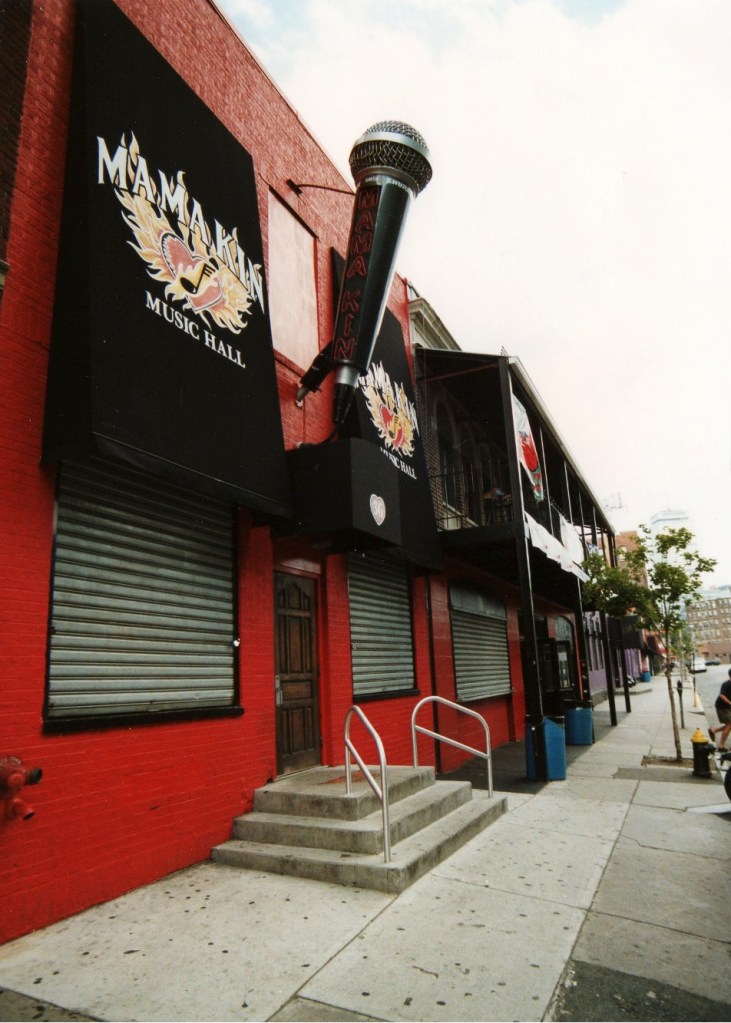
Boston had always claimed Aerosmith as favourite sons, but in December 1994 the band returned the affection in concrete, brick and 4 000 screaming watts of amplification. They christened their new Lansdowne-Street clubhouse Mama Kin Music Hall, and Steven Tyler never tired of explaining the name: “Mama Kin was the first song I wrote. I poured what I knew into the piano, the guitar, and that gave birth to ‘Mama Kin’. So, I took that title and named the club after it. Now, with the big microphone out, people come from all over the world to try our ‘brew of the month’, some of Aerosmith’s famous sanctified mead.” The venue, opened with nightlife partners Pat Lyons and Ed Sparks, was conceived as a working-band’s utopia: a pristine house PA, a basement recording studio and a second stage that could be wheeled in when demand outgrew the first.
Joe Perry spelled out the blueprint with characteristic bluntness: “You know we wanted to put out there a good sound system in there, a recording studio in the basement, and those things preatty much lived up to that. One of the things we wanted to make sure of is that the sounds system was great, because one of the thing when you are playing on clubs is that the sound always sucks, so, that one of the most important things for us, to make sure it sounded good, and it sounded good.” Tyler put the sales pitch in language only he could manage: “4000 screaming watts of sound, which will raise or lower your socks at any given moment.” He warned green bands, though, that top-shelf gear was a double-edged sword: “With all the good equipment to play out of here, its not gonna make your band sound any better, if you sound like crap, you are going to sound double time crap out to the house from the bigger stage.”
The décor matched the swagger. Local graffiti artists pre-tagged the bathrooms; Tyler sprayed “Squat This Way” above the men’s loo while Perry scrawled a giant set of Aero-wings. The backstage lounge earned a name of its own when Tyler guided MTV’s Week-in-Rock crew through the club in May 1995: “This is our whooping parlour, its all part of the scene, you know, if someone has a thing to say in a big way or a small way or whatever, and they have the time, they can come over here and do it, and play. You know spoken word is really up and coming now so maybe someday plays will come back in a big way or small way or whatever if we got the time they can come in here and do it and you know plays. You know spoken word is really up and coming now so maybe someday plays will come back.” Perry added a mischievous alternative for stage-shy hopefuls: “and if you cant make it on the stage with instruments, you know, you can always come here and try a hand of thespianism.” Outside, Tyler greeted the MTV cameras with a Dorothy-meets-Dr Seuss couplet: “Welcome to our home away from home, there is no place like home-sweet-home, its better far than ritches, cause’ when you are in your own sweet home, scratch in the place that iches.”
The doors swung open publicly on 19 December 1994. Tracy Bonham warmed up the crowd, Aerosmith tore through a nostalgia-rich set that leaned on Train Kept A-Rollin’, Same Old Song and Dance and a stack of early-70s deep cuts, and the entire take – US$10 000 – went straight to Boston’s homeless fund. “We want to thank Mayor Menino and all the boys and girls in Boston government who are going to help us keep our clubs open later in Boston,” Tom Hamilton beamed while handing over the cheque. A live FM simulcast escaped into bootleg circulation, proof that Mama Kin could already sound like a million-seat arena. From that point the calendar filled quickly: unknown locals on week-nights, national names like No Doubt and Marilyn Manson at weekends, and occasional guerrilla visits from the owners themselves.
The pinnacle arrived on 10 November 1995. Rumours had buzzed for days that Aerosmith, off the road for almost a year, would test-drive new songs under the cheeky alias The G-Spots. Tickets – a laughable seven bucks – were cash-only at three hometown record shops, and on show night the queue on Lansdowne Street curved past Fenway Park. Club staff, clocking the wind-chill, dispensed Styrofoam cups of hot chocolate. Security, meanwhile, treated every fan as a suspect smuggler of DAT decks. Inside the 200-capacity sweatbox Tyler made the understatement of the decade: “Good evening. As you already know, we’re the G-Spots.” Over the next ninety minutes the band premiered four unreleased tracks – Trouble, Something, The Farm and What Kind of Love Are You On – jammed through blues standards, and let Tyler hijack Hamilton’s bass during Sick as a Dog while the bassist rattled maracas. Joe Perry and Brad Whitford traded feral slide licks on I’m a Man, Tyler read the power-ballad Hole in My Soul from a lyric sheet abandoned on a music stand the night before at Cambridge’s Middle East, and WZLX announcer John Laurenti floated out afterwards muttering, “best show I’ve ever seen Aerosmith play.” Only the in-house camera rolled, the tape sealed immediately inside the band’s fabled Vindaloo Vault. For almost three decades the footage was considered lost – until June 2025, when Aerosmith’s social feeds dropped a clip of S.O.S. (Too Bad) from this show labelled “from the vaults.” Instantly the fanbase revived its oldest prayer: that the holy-grail show might yet surface complete.
Even at its height Mama Kin was a tug-of-war between artistic idealism and bar-room economics. Aerosmith, long sober and bent on nurturing local talent, were now in business with partners whose empire relied on liquor turnover. The Boston Globe reported tensions as early as mid-1996; Joe Perry grumbled, “Management is not happy, but that’s not what it’s about for the long run. We want to keep the place so people know that they can come here and get seen.” Structural fixes were floated – knocking out a wall to create a single 900-cap room, splitting the licence down the middle – but nothing stuck.
Still, the magic lingered. Brad Whitford slipped on stage with Gov’t Mule for Born Under a Bad Sign in December 1995. On 13 January 1998 thousands lined Lansdowne in sub-zero wind to have Walk This Way signed by all five band-members, then squeezed back inside three nights later for a seven-song NEMO-conference blitz that Boston critic Steve Morse called “a metallic valentine… the band jammed with a ferocity that left the elbow-to-elbow crowd in a state of total ecstasy.”
Six months later the fairy-tale faded. Constant touring made “hands-on” ownership impossible, and on 5 January 1999 Aerosmith sold their share to the Lyons Group. “We’re sorry to do this, but we had a good run,” Perry sighed. “A lot of people had a lot of fun in Mama Kin, and that’s how I want it remembered.” The sign came down, the room was rechristened first the Lansdowne Street Music Hall, then Axis, then Avalon, and finally – in today’s Live Nation era – the House of Blues. Tyler couldn’t resist a last wink at history when he joined the John Mayer Trio on that stage in 2005 and crowed, “I used to own this place.”
Between 1994 and 1999 Mama Kin hosted at least 220 documented shows, launched countless demo tapes from its basement studio and gave Boston four nights – the opening blow-out, the “G-Spots” shocker, the Whitford/Mule jam and the 1998 NEMO set – that still ripple through Aerosmith lore. It also left rock fans everywhere with an unanswered cliff-hanger: if the newly digitised 1995 clip can stream on Instagram, how long before the entire film, unreleased songs and all, finally blasts out of the Vindaloo Vault? Until that day, the graffiti in the bathroom says it best: Squat This Way and remember where the legends once roared.
 The Back-Burner: Aerosmith Outtakes & Demos