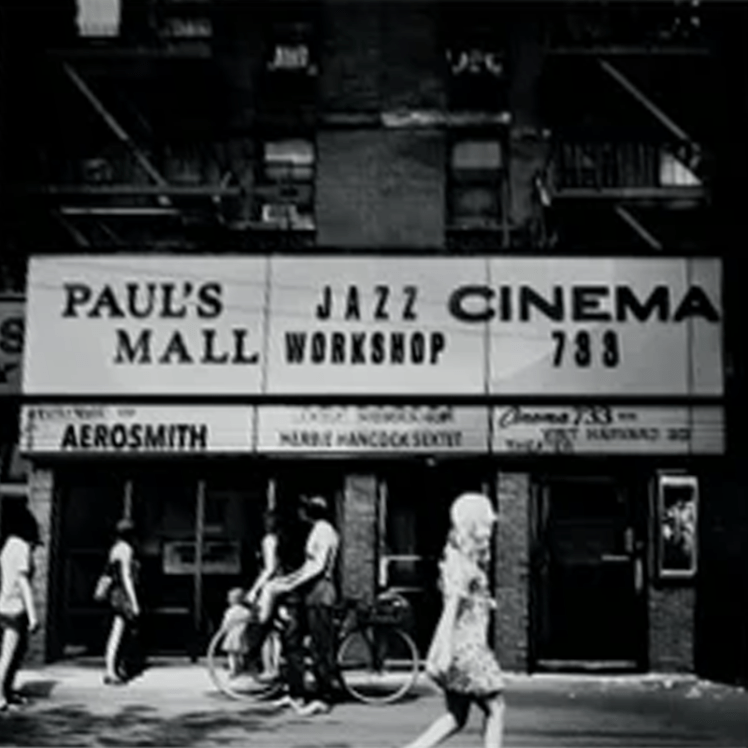
Aerosmith (Legendary Edition) finally made Paul’s Mall an official part of the band’s catalogue, this recording had already spent decades living one of the strangest double lives in Aerosmith history. It was never exactly lost. Collectors had known it for years, traded it in several forms, argued over its date, its completeness and its best source, and heard fragments of it slip into the official discography. Yet for all that circulation, Paul’s Mall still felt half-mythical: an early live document from the Boston club circuit, preserved through radio tape lineage, local memory and bootleg culture, but never fully settled until now. The new set finally gives it that status, presenting the show on disc three as Live at Paul’s Mall, March 20, 1973, drawn from what the production team says was an original quarter-inch analogue two-track tape.
That date matters. For years, one of the central points of confusion around this performance was whether it came from March 20, 1973 or April 23, 1973. The older official trail helped muddy the waters. The live versions of “I Ain’t Got You” and “Mother Popcorn” that later appeared on Live! Bootleg have long circulated with metadata identifying them as “Live at Pall’s Mall, Boston, MA – April 1973,” a spelling and date combination that became embedded in fan memory. But newer official material for Legendary Edition now fixes the show firmly as March 20, 1973, and the WBCN historical material agrees: Aerosmith played Paul’s Mall only weeks after the debut album came out, and the performance was broadcast live on WBCN-FM, introduced by station announcer Maxanne Sartori.
That makes the concert more than just an early gig. It places it at a crucial turning point in the band’s rise. Aerosmith’s debut album was already out, but the group was still very much a local phenomenon, fighting to turn club heat into something broader. WBCN was central to that process. The station’s later historical account says the March 20 broadcast was likely the first time most radio listeners had heard Aerosmith, and that Maxanne Sartori, who introduced the band on the air that night, would later be credited with helping launch them through local airplay. The Music Museum of New England goes further, noting that Sartori persistently championed the group at WBCN and helped jump-start the local support that kept them alive in New England while the debut album was still slow to break nationally.
The story becomes even better with Steven Tyler’s own memory from the new box-set notes. “I was hanging out with Maxanne Sartori who was a jock at BCN,” he recalls. “I went out with her for a couple of months. We had a chance to play Paul’s Mall, and she said, ‘Why don’t you get the band together and play live over the radio?’ The rest is history.” It is a very Aerosmith origin point: local scene connection, club energy, radio instinct and just enough chaos to become legend.
The show itself deserves that reputation. Even stripped of mythology, it is simply a superb document of early Aerosmith in their natural habitat: loud, lean, swaggering, blues-drenched and still close enough to the clubs that nothing feels overworked. The official Legendary Edition tracklist runs as follows: introduction, “Make It,” “One Way Street,” “Somebody,” “Write Me A Letter,” “I Ain’t Got You,” “Mother Popcorn,” “Movin’ Out,” “Walkin’ The Dog,” “Train Kept A Rollin’,” and “Mama Kin.” It is almost a perfect snapshot of the first-album era, but more importantly it captures what the band sounded like before stardom hardened the edges of their act. The setlist is part album showcase, part bar-band R&B assault, part preview of the attitude that would define them for the next decade.
And yet the version fans have known for years was never quite one fixed thing. The Paul’s Mall, Boston recording circulates from several bootleg sources, but nearly all originate from a WBCN radio station reel-to-reel recording made for broadcast. The cleanest versions come from pre-FM soundboard reels, which offer the best fidelity but are often missing the opening track “Make It.” Other widely traded copies come from FM broadcasts recorded by listeners, which sometimes include “Make It” along with DJ introductions, though with slightly rougher sound. More recent releases combine two incomplete pre-FM sources, using the cassette-derived opening and the cleaner reel source for the rest of the show to reconstruct the most complete version. In short, the differences between circulating versions mainly come down to audio clarity and completeness, with modern hybrid edits providing the closest representation of the original broadcast.
What Legendary Edition adds to that story is not just official status, but a small technical confirmation. The producer’s note says that “every effort was made to present the best possible audio fidelity” and that an original 1/4″ analog 2-track tape was sourced for this production. It also frankly acknowledges “minor flaws” in that source tape, while insisting that they “cannot dull the exuberance of the band’s performance at this seminal early Aerosmith concert – the launch gig for their debut album, March 20, 1973.” That one note does two important things at once: it validates what collectors had long suspected about the tape’s roots, and it frames the release not as some random live extra, but as a genuinely historic launch-night document.
The new credits from the box also sharpen the picture further. The Paul’s Mall recording is credited as having been recorded on March 20, 1973 at Paul’s Mall, Boston, MA, with David “Woody” Woodford on saxophone and Maxanne Sartori as announcer. The analogue-to-digital tape transfers are credited to Carl Plaster, with the source tape courtesy of The David Bieber Archives.
It is also worth remembering that Paul’s Mall was never entirely absent from the official Aerosmith story. “I Ain’t Got You” and “Mother Popcorn” escaped into the band’s catalogue years ago through Live! Bootleg, which is why so many fans knew the performance without necessarily knowing the full broadcast. But those two tracks only hinted at what made the tape special. Heard in full sequence, Paul’s Mall feels less like a couple of salvageable live cuts and more like a complete portrait of what Aerosmith actually were in early 1973: not yet national stars, not yet a fully finished recording act, but already a dangerous live band with a tight identity and a local audience ready to carry them.
 The Back-Burner: Aerosmith Outtakes & Demos
One thought on “Paul’s Mall: the definitive story behind Aerosmith’s March 20, 1973 show”