On June 25, 2001, Aerosmith stood inside Cipriani’s on 42nd Street in New York City to announce their partnership with Dodge, tethered to the rollout of the all-new 2002 Ram. Steven Tyler wielded a can of spray paint and tagged the tailgate of a Ram truck on stage. Robot women styled after the Hajime Sorayama gynoid on the Just Push Play cover posed alongside the vehicles. The truck would travel with the band on tour and be auctioned off for charity. A dedicated website, dodgeaerosmith.com, went live. Photo archives from that day, shot by Evan Agostini and Theo Wargo, still exist, and a detailed fan archive at rockthisway.net preserves the original press materials.
The Aerosmith connection came together through Peter Arnell, founder of the Arnell Group. According to a Forbes profile, when Chrysler execs wanted Aerosmith’s music for the Dodge Ram commercials, they were told by one agency that the band wouldn’t sell rights to its music. Arnell picked up the phone, called Tommy Mottola at Sony Music, and learned that Aerosmith needed a title sponsor for an upcoming concert tour. The deal came together fast. Ad Age later confirmed that “the Arnell Group made the connection with Aerosmith, and then Omnicom’s PentaMark was instructed to integrate the band into Dodge’s campaign.” Tempus Fusion, a Westport, Connecticut firm, handled the experiential and tour sponsorship side. According to Jim Schroer, Chrysler’s executive vice president of global sales and marketing, the initial worry was that the band might be too outrageous for DaimlerChrysler’s management. As it turned out, everyone loved the idea. Aerosmith, who had been in talks with another car company outside the US, signed on with Dodge instead. It was the band’s first-ever corporate sponsor. Tom Hamilton put it plainly: “We’ve been playing and touring for 30 years and have never had a corporate sponsor. But when Dodge asked if we would be interested, we thought it would be a great fit for a touring band like us… cars, trucks and racing. It’s all rock and roll.” Tyler, characteristically, offered his own take on the product: “What does ‘Ram’ stand for? Ready, Aim, Meet me in the backseat.”
The deal was steered on the Dodge side by Julie Roehm, Director of Dodge Marketing Communications, who had arrived at DaimlerChrysler weeks earlier with a mandate to turn around a brand bleeding sales, down over 16 percent through the first five months of the year. The outgoing campaign, “Dodge Different,” had been fronted by actor Edward Herrmann in a three-piece suit on a clean white stage. Roehm wanted the opposite. As she later recalled, the shift was “streetsmart versus booksmart,” and she reportedly took a helicopter ride to personally book Tyler. At the press conference she signalled the scale of what was coming: “Trust me, this is just the very tip of the iceberg. We have plans in the works that will touch every element of the Dodge family, customers, dealers and employees.” The new tagline, “Grab Life by the Horns,” replaced “Dodge Different” in August 2001. Schroer told UPI the ads would be “bold and uncompromising, a little edgy and occasionally confrontational, but always fun.” The Orlando Sentinel covered the early skepticism from industry analysts about whether buyers would relate to a band that had been touring for 30 years.
The activation went wide quickly. Dodge sponsored Aerosmith’s 48-city Just Push Play US tour. A concert video was edited to open some of Aerosmith’s shows, further confirming the depth of content created for the partnership well beyond the broadcast spots. A limited run of Aerosmith-branded Rams was produced, with Joe Perry telling LAUNCH on the day of the announcement: “I think it’s gonna be a pickup. We’ll have some influence over it, some input.” A private concert was planned for consumers who purchased the new truck, as Adweek reported. Dodge also launched Truckville as a 25-city mobile marketing tour and experiential event, bringing hands-on introductions to the new Ram directly to consumers.
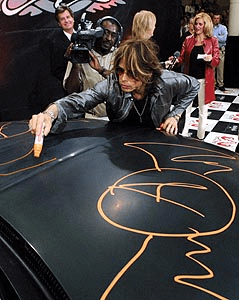
On July 12, 2001, the band took a day off from the tour to visit DaimlerChrysler’s Technical Center in Auburn Hills, Michigan. More than 1,500 employees turned out, standing three and four deep around the railings and lining the escalators. Just Push Play tracks echoed off the ceiling of the Pentagon-sized building’s covered plaza. The crew wore black T-shirts reading “July 12, 2001. Live, Aerosmith does Dodge at DCX.” Tyler spray-painted another all-black Ram on site, then the band was whisked to the test track out back to drive Vipers and preview the 2003 Viper RT. An AP photo by Duane Burleson of Tyler writing “Aerosmith” on the hood of the Ram became Photo of the Day on Canada’s Canoe entertainment network. Perry, meanwhile, summed up the Viper: “It’s everything your mother warned you about.” Footage of the Auburn Hills visit, including the band walking through the facility, survives in a production sizzle reel by Andor Steven Czompo, who worked as staff director at Ross Roy Communications and BBDO between 1996 and 2003. Ross Roy was DaimlerChrysler’s near-captive marketing services agency, handling merchandising and internal production across all Chrysler divisions.
The television campaign launched in September with two 30-second spots, “Reflections” and “Truckville,” during Monday Night Football on ABC. Creative came from PentaMark Worldwide in Troy, Michigan, with Bill Morden as chief creative director. Production was by Ritts/Hayden in Los Angeles, directed by Lance Kelleher and shot by Sal Totino on location in Irwindale, California, Salt Lake City, and Astoria and Salem, Oregon. Visual effects were handled by Digital Domain; editorial by Rock Paper Scissors. Roehm described the look as having “a real American truck attitude: proud, tough and full of energy.” The monochrome palette, the cinema-grade CGI, and remixes of “Just Push Play” gave the spots a weight that set them apart from standard truck advertising. Full production credits were documented by SHOOTonline at the time.
Those early chapters, “Reflections,” “Truckville,” “Baggage Claim,” are the ones most people can still track down, viewable across multiple YouTube uploads (here, here, and here). By April 3, 2002, an Outta Your Head TV ad was airing, and by April 20 one using Sunshine.
None of these featured the band performing on camera. But the campaign worked. By late November, Joey Kramer was telling Billboard: “The commercial is what is selling that song right now. We have so many requests for it at radio, via the commercial, that we ended up releasing it as a single.” Mainstream top-40 spins for “Just Push Play” jumped 350% in a single week. Columbia had been planning to push “Sunshine” beyond rock formats instead, but the Dodge-fuelled demand made the title track the obvious call.
The real pivot came in October. AF1 and later Blabbermouth quoted Tom Hamilton saying the band had shot a Dodge commercial “last week” in which they appear performing both “Under My Skin” and “Light Inside.” Recording took place in an old warehouse in Los Angeles. Hamilton added: “It’s interesting having this giant corporate entity wanting to use deep rockers from the new album. We’ll get our musical message out to the far and wide.” That pins the filming window to roughly October 10 to 21, and confirms that Dodge produced at least one performance-based spot using “Under My Skin.”
The same Billboard piece that quoted Kramer also nailed down the air date. In that November 27 interview, Kramer confirmed that “beginning next week, a different Dodge commercial using the same track will be airing with Aerosmith appearing on camera.” That places the on-camera debut in early December 2001.
Everything about this spot set it apart. Where “Reflections” and “Truckville” lived in monochrome, this version was in full colour with a distinctly industrial look. The narrative, as consistently remembered by viewers, follows a young woman working on an assembly line inside a gritty factory. Metallic, harshly lit, all steel and mechanised rhythm. Intercut with her work are shots of Aerosmith performing “Under My Skin” on a matching industrial stage. The spot ends with the woman stepping outside, finding the band waiting beside the truck, and giving Steven a high five and then driving off together in a red truck with the Aerosmith logo on the plate.
A :60 cinema version called “Grabbin Life By The Horns,” dated 11/26/01, was uploaded to YouTube by Peter Arnell, the man whose Arnell Group brokered the Aerosmith-Dodge deal in the first place. The date, one day before Kramer’s Billboard interview confirming the on-camera spot would debut “next week,” locks in the timeline precisely.
In May 2002, Adweek reported that Aerosmith would make their “first onscreen appearance” for Dodge in a spot running exclusively in movie theatres that summer. Chrysler VP of marketing Jeff Bell confirmed to Adweek that the contract was “open-ended.” Dodge had spent $500 million on measured media in 2001 alone. Given that the :60 cinema version already existed from November 2001, the Adweek report likely referred to the wider theatrical rollout: a 60-second Dodge/Aerosmith commercial, also titled “Legends of Rock, Legends of Roll,” debuted on May 24, 2002 and ran through June 28 across 2,400 movie theatres (18,000 screens) in the continental United States. That piece was an advertisement for the Dodge concert contest and showed pictures and video clips while playing “Just Push Play.”
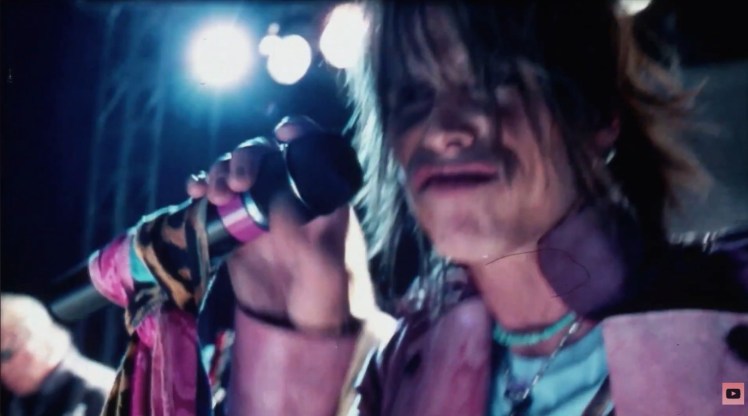
Fragments from the October performance shoot also survive in a restored compilation often labelled the “Dodge Legends Sweepstake” commercial. At around 0:58, there’s a close-up of Tyler in a pink jacket, a shot from the same industrial set. A separate shot of Tyler on the same set without the pink jacket also appears in the compilation, likely from the “Light Inside” portion of the shoot. Hamilton confirmed both songs were filmed, but no standalone “Light Inside” edit has ever surfaced, suggesting it was shot as contingency material, coverage in the can in case a follow-up spot was needed, but never cut into a finished piece.
It’s worth noting that the Aerosmith partnership, for all its creative ambition, reportedly did not go over well with Dodge dealers. Ad Age noted as much in a later profile of Peter Arnell’s career. That tension may help explain why the performance spot had a shorter run than planned, and why so much of the filmed material never saw wider distribution.
For years, the “Under My Skin” performance spot seemed to be one of the more tantalising lost artefacts of the Just Push Play era: documented in trade press, confirmed by the band, dated to air by Kramer himself, but available only in fragments and production reels. Its quiet reappearance on YouTube, uploaded by the very man who brokered the Aerosmith-Dodge connection, closes one chapter while leaving others open. The “Light Inside” footage from the same October shoot remains unaccounted for. And if a full performance was filmed across multiple takes and camera setups in that Los Angeles warehouse, far more material likely exists than what was cut into this 60-second cinema edit. Whether that sits in an archive at PentaMark, the Arnell Group, Ross Roy, or a DaimlerChrysler storage facility is anyone’s guess.
 The Back-Burner: Aerosmith Outtakes & Demos